

Hello, and welcome back. Jessie and Shelby here, back from weekends full of spring-time hobbies. Jessie indulged in softball, buying a flat of plants (so many cherry tomatoes!), vegan tiramisu, taking a long coffee walk and finishing this thriller. Shelby met up with her Canadian Poynter cohort (hi ladies!), built a chair, put her travel photos up and continued reading her book. Same weekend, but different!
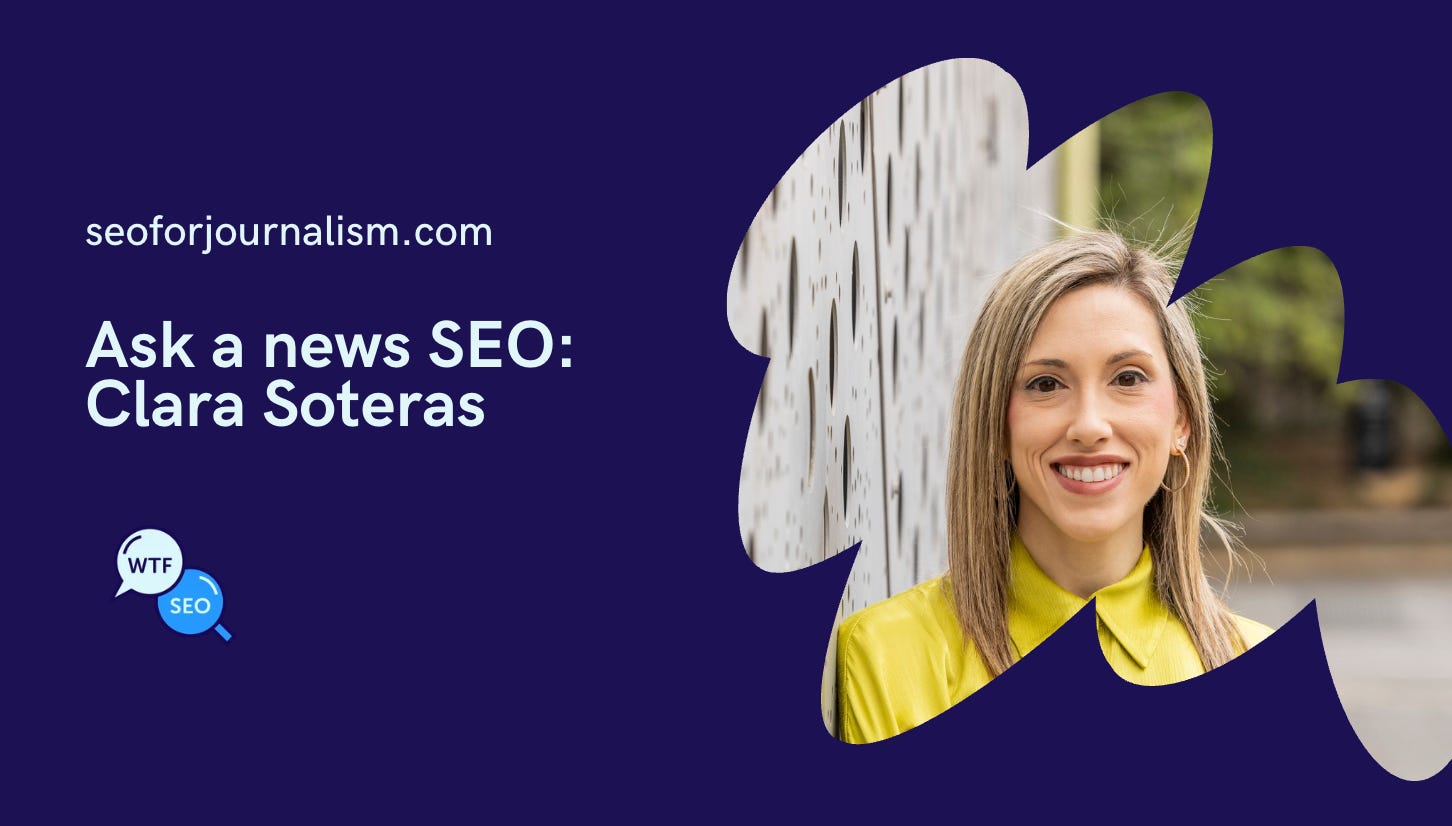
This week: Ask a news SEO! We’re thrilled to be joined by digital strategy and news SEO consultant Clara Soteras! We talked about all things creators and authorship, and the most underrated soft skills.
☀️ There’s a Canadian holiday next Monday! This means Jessie and Shelby will be catching some sun (maybe, tbd) and there will be no issue. We’ll be back Tuesday, May 26th, to accommodate the U.S. and U.K. holidays.
🚨 SOON! Our spring community call is Wednesday, May 20 at 11 a.m. ET/4 p.m. GMT! In partnership with Trisolute News Dashboard, Steven Wilson-Beales will join us to discuss all things podcast SEO! Register to receive a reminder and ask a question.
Let’s get it.
THE INTERVIEW
WTF is SEO?: How do you define creators and authorship for SEO?
Clara Soteras: We can define it as somebody with authority, knowledge and expertise about a product, category or section.
It’s something we have to take into account nowadays in newsrooms. We have to recognize the value that every journalist can add to your editorial brand. It’s time for authors and creators to achieve and grow brand visibility for publishers.
WTF is SEO?: If you are a content creator, what are the things on your checklist for growing your visibility on search?
Clara Soteras: If I were a content creator, this is the moment to start to build brand visibility. It’s something that I am trying to explain to publishers and journalists. It’s really important to have a website and to claim your Knowledge Panel to create consistency with social networks.
But, it’s also understanding how we need to approach every platform. We need to understand where our audience is and what type of audience we have.
For example, if a content creator is an expert in technology and shares something related with new gadgets, she probably needs to understand that she needs to publish visual content on TikTok or YouTube.
But, if you work in the culture section and you really love writing and connecting with your audience, you probably need to create a community. You need to create, for example, a newsletter — another platform to create engagement and connection with your audience.
It’s important to have a domain to refer back to for your brand. If you don’t have a website, it’s probably difficult to have a Google Discover profile, or to get a Knowledge Panel.
It’s the moment to evangelize this as an SEO in the newsroom. Sometimes, I work with different types of people and journalists who know that we are evolving, and that SEO is evolving, and they are open to change the way they work. But in another way, you can work with journalists that only write and only want to create the text piece of content. They think it’s not necessary to add value on other platforms because they don’t work in distribution. But, that’s not the reality today.
WTF is SEO?: If you’re an SEO at a website and you want to boost your authors, what are the main levers you should pull to grow a writer’s E.E.A.T, topic authority, etc., in order to build visibility?
Clara Soteras: The first thing, obviously, is that you need to create good author bio pages.
You need to work on the schema, on the social networks, on a good biography that has a good explanation of the background of the journalist.
But it’s not the only thing that we can do. We can create author pages for our website, but we can also train journalists on how to publish and distribute their content in LinkedIn, for example, if it’s something related with business or technology. We need to create this social conversation.
If we use Instagram or YouTube Shorts, we can tag the relevant people and ask our journalists to share this knowledge, to share this post.
As publishers, I think that we need to offer this training or these tips to our journalists if we want them to rely on our strategy. It’s something that is needed to create this consistency.
We can start with the author pages, and after that, create a community with authors that are the most recognized [for the] brand or trying to create this collaborative post on Instagram or LinkedIn.
WTF is SEO?: Does this change if people are thinking more about AI than traditional search?
Clara Soteras: Something that we can work on is understanding how personal brands are appearing in AI — not only the publisher. Obviously, the publisher needs page views, but something I am trying to work on with my clients is to increase the dimensions and being the source of different prompts to be more in the mindset of people.
I think that we need to understand how every LLM is mentioning our brand. We can track the best prompts that mention our content, and try to find what information and type of searches people are looking for.
I think that we can create consistency with our authors. We need to create more visibility on our homepage for our people.
It’s something that generates more connection and engagement with the community than the publisher brand. We need to encourage our authors and creators to be a name, and give them the opportunity to talk directly to the audience, always mentioning that they are journalists who work for our publication. It’s complicated to manage if you don’t have strategic thinking.
We can mention The Washington Post example. People who created TikToks for The Washington Post, they decided to create their own project independently. Now, they’re very big names and they have their own project. For this reason, I think that we need to find some way to promote our journalists, but always with a dedicated brand and having connection with the audience.
WTF is SEO?: You mentioned The Washington Post. It’s illustrative of this tension between publishers and creators, but how should individual authors and creators coexist with existing news brands?
Clara Soteras: This is really different depending on the market and the audience. If you analyze different content creators in different countries, the people connect really differently. Something that works in the United States won’t work well in Spain, and we need to manage and understand the needs of our audience. All journalism work is based on the needs of our audience.
WTF is SEO?: If you’re a publisher, what are sort of the risks around working with and focusing on creators?
Clara Soteras: The first risk is something that occurred at The Washington Post. You help create a name and relate the name to a brand, then people can start their own career. That’s the first risk. But publishers need content creators. When something newsworthy is explained by a journalist, a name and surname, it performs better than if you explain as a publisher.
It’s how you can create this connection with new audiences. It’s the way to attract them. Publishers need to work and understand the new way to connect with new audiences with content creators. We need to have balance. We need to take care of our creators because you can use them. We need to to create a good relationship with them and grow together because if we think that yes we will add some creator in our publisher for some months to because we need now to increase the page views or the the connection. It’s not a strategy for the long term.
WTF is SEO?: You recently published a book. What was your biggest tip or takeaway from that?
Clara Soteras: Some people think that it’s not a good way to explain SEO, in a printed book, because it can get outdated. But it’s not the case. The book is the basics. It’s the basics to explain to journalists what is working on the net and what we need to work on for SEO in the newsroom.
Yes, we have GEO and LLMs and AIOs, but the basic things are the same. In the book, I can give some examples and I can offer different ways to evangelize SEO in the newsroom for people who work on SEO, but don’t have this type of skills or knowledge to connect and to transmit.
It’s like you are translating the SEO topics and SEO basic things to journalists, to directors of business, to understand why we need SEO.
For example, there’s a chapter to talk about soft skills, and how to organize and SEO team, and organize different tasks — for example, on election night, the coverage for the SEO team.
I’ve received feedback from people across different newsroom roles, editorial teams and content professionals saying that it’s really useful as a way to build strong foundations and share them with people who want to better understand SEO and grow in this space. You can apply this to every publisher.
WTF is SEO?: What is the important soft skill for people working in SEO?
Clara Soteras: I think that understanding the needs of the journalist and the resources that you have to prepare a good strategy. If I prepare a strategy for a huge publisher, obviously we can cover an election night with 50 people — but if we don’t have 50 people in the newsroom, I can’t properly do that. If nobody knows how to work with Google Trends, for example, or understand why we need to publish within two minutes of breaking news, that strategy isn’t useful.
The best soft skill is this understanding needed in our newsroom, understanding the resources and the knowledge of our journalists.
#SPONSORED - The Classifieds

Get your company in front of more than 14,000 writers, editors and digital marketers working in news and publishing. Sponsor the WTF is SEO? newsletter!
THE JOBS LIST
Audience or SEO jobs or opportunities in journalism. Want to include a position for promotion? Email us.
The Guardian US is hiring an Audience Engagement Editor (California, New York, or D.C.).
Applications are now open for the ONA Women’s Leadership Accelerator program.
RECOMMENDED READING
Google news and updates
🤖 Google: Five new ways to explore the web with generative AI in Search.
🤖 Barry Schwartz: Google will no longer support FAQ rich results.
🤖 Barry Schwartz: Google has updated links within AI Overviews and AI Mode.
Even more recommended reading
🎤 Steven Wilson-Beales: How to grow a podcast: Product, people and promotion.
🏆 Ashley Liddell: SEO’s new goal in 2026: Recognition, not rankings.
#️⃣ Cyrus Shepard: AI citation ranking factors analysis.
👁️ Aleyda Solis: A Google logging error prevented Search Console from accurately reporting impressions.
👋 Anthony Ha: Farewell, Jeeves: Ask.com shuts down.
What did you think of this week’s newsletter?
(Click to leave feedback.)
Catch up: Last week’s newsletter


Have something you’d like us to discuss? Send us a note on Twitter (Jessie or Shelby) or to our email: seoforjournalism@gmail.com.
Written by Jessie Willms and Shelby Blackley