

Hello, and welcome back. Shelby here, reporting live from beautiful Chicago, Illinois. The Athletic brought its football contingent together so we could operate in-person like a real newsroom for an NFL Sunday. Much deep dish pizza was eaten and many profanities were yelled at televisions. The Ravens somehow pulled off what can only be described as a miracle with a last-second field goal. Objectivity was not in the newsroom then!
This week: Entity SEO 101. The concept of entity SEO is not new, but is increasingly important in an AI world. We explain what it is and why it matters. We’ll go more in-depth in another newsletter.
🚨 Happening this week! Barry Adams will join our September 30 community call to discuss all updates to Google Search Console, presented in partnership with Trisolute News Dashboard! Register and ask us a question!
Let’s get it.
THE 101
What is entity SEO?
Entity SEO is the concept that publishers should create and optimize content on clearly defined, real-world topics rather than focusing on standalone, isolated keywords. Traditional SEO has prioritized targeting specific terms with high search volume, regardless of whether the subject was covered in-depth by the site. Entity SEO moves beyond that, considering which topics (entities) a site wants to own and cover in-depth, with expert knowledge.
While the name may seem “new,” entity SEO really is a long-standing concept — focus on things, not strings, just like Google has said since 2012. Google’s Knowledge Graph system is a reflection of the company’s continued pursuit (for better or worse) to display the top sites for a specified category, not keyword.
Friend of the newsletter and audience strategist Harry Clarkson-Bennett wrote in-depth about how entities are the foundation of modern SEO. Large language models (LLMs), the machines that power most artificial intelligence systems, evaluate content and its relevance to a prompt by string matching of content and the semantic connection between it. As AI becomes a mainstay in the search ecosystem, publishers understanding how LLMs use entity analysis to evaluate content is imperative.
Entity SEO focuses on owning the topics your publication is an expert in, and doing it across the entire internet. This requires sites to write in-depth, helpful journalism, while connecting it altogether with internal and external links, on-site and on external platforms.
Entity SEO takes brand awareness to the next level. It is the crux of how publishers perform well on the internet and protect against spam penalties or straying too far from their lane.
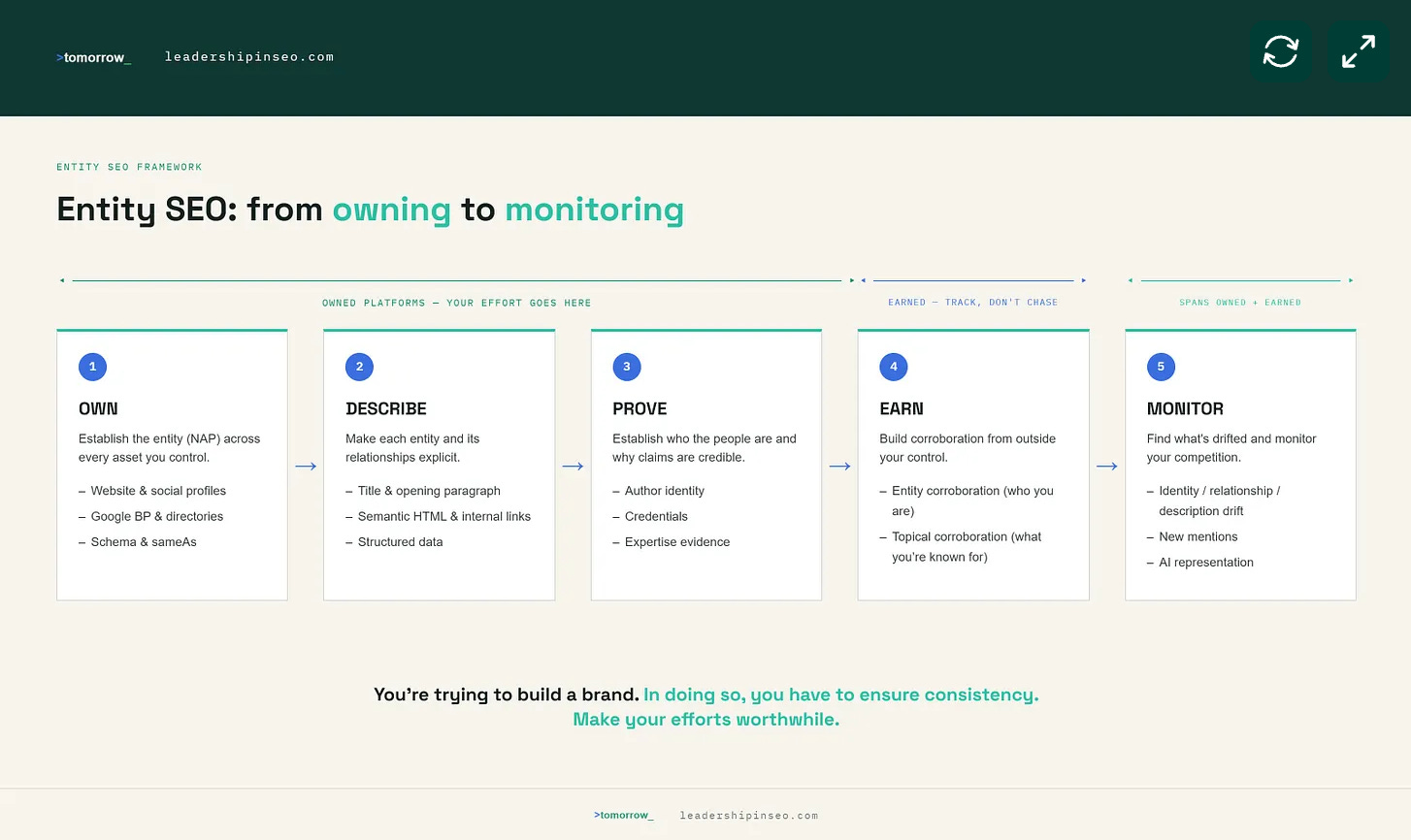
🔗 Read more: Entity SEO: The definitive guide
Why is entity SEO important for news publishers in the age of AI?
Put simply: In an era where AI Overviews show up on over 43 per cent of search engine results pages, it is crucial that publishers lean into the topics they are experts on and can cover constantly with authority.
In the last several years, searching as a behaviour has evolved, moving beyond thinking about “search” as just Google, and understanding that topic authority and E.E.A.T play a crucial part in how sites are selected across LLMs, chatbots and AI surfaces. The more you are regarded as an expert on a topic, the more likely you are to be cited or mentioned in an AI response.
“Generative Engine Optimization,” then, is just another fancy name for entity SEO. AI models do not evaluate web pages by keywords; they process everything as part of its summarized response, to understand meaning, truthfulness and authority.
AI models require a clear understanding of entities that are covered by a site when conducting information retrieval. It must be very clear — through links, category pages and breadcrumbs, among other on- and off-page tactics — what topic the story covers and how it connects to the greater topic.
Additionally, entity SEO is a surefire way to avoid a spam penalty and provide quality information over commodity content. Sites that just focused on search volume — writing on an array of topics with the focus on keywords and just trying to rank well on Google — no struggle to see the same return. Commodity content is easily synthesized.
To stand out, publishers need to provide original perspectives, first-party data and analysis or clear expertise that shows they’ve been hands-on with the topic in question.
Here are a few other reasons why entity SEO should be the focus of your publisher strategy:
It goes beyond the search results. Entity SEO ensures that you are showing what topics your site is an expert in across the entire internet. As Google provides more information on how social media channels perform on SERPs, it’s critical that everything about your brand is connected. (Entity recognition is also extremely crucial for Google Discover, which reflects a user’s topics of interest.)
Authorship is prevention for AI slop. People want to trust humans, and they want to know that a real person is giving them advice and quality information. Journalists should showcase all of their expertise on their personal channels, while linking to their author bio and all of their stories. Additionally, using Schema.org structured data markup (
sameAsattributes for things like LinkedIn, Wikipedia, Google’s Knowledge Profile, etc.) can help Google understand the connection between various sites that have information on a similar person.It protects a brand from “entity drift.” For a very long time, it was easy for sites to write on any topic and see traffic from Google. This has changed. Google’s algorithms learn what sites are about and will distinguish them based on such. If a site is writing too much outside of its topic authority, this could confuse search engines (and readers) about the publisher’s core authority, and hinder its performance.
As traffic struggles continue, publishers should not chase the click. They must focus on the qualified click — a person who really values the coverage and wants to explore further.
In a future newsletter, we’ll dive into the best practices for considering entity SEO, including how to best set up your site for topics.
The bottom line: Entity SEO is not a new concept, but has become a pivotal part of a publisher’s search strategy. Consider what your publication is an expert in, or wants to be known for, and lean into this where you can. It is vital to avoid any spam penalties or reasons for LLMs to discredit your coverage.
#SPONSORED - The Classifieds

Get your company in front of more than 14,000 writers, editors and digital marketers working in news and publishing. Sponsor the WTF is SEO? newsletter!
RECOMMENDED READING
Google news and updates
🤖 Google: The September 2026 spam update began rolling out on September 24. Updates can take up to two weeks to complete.
🤖 Matt Southern: Google released a Multimodal Filter in Search Console, enabling filters for Text and Multimodal searches.
Even more recommended reading
🔗 Matt G. Southern: Google AI Overviews have more links, but they’re not all the same.
🧑💻 Damien Andell: How Google Discover puts the author and creator even more at the center.
🤔 Adam Gent: Why are pages not indexed in Google?
👎 Danny Goodwin: Google’s AI Mode reduces clicks and user satisfaction, according to a new study.
🗺️ Dayna Lucio: How to segment SEO data for multi-location brands.
What did you think of this week’s newsletter?
(Click to leave feedback.)
Catch up: Last week’s newsletter


Have something you’d like us to discuss? Send us a note on LinkedIn (Jessie or Shelby) or email us (WTF is SEO? Newsletter).
Written by Jessie Willms and Shelby Blackley
Excellent summary!