


Hello, and welcome back. Jessie and Shelby here, back from jam-packed weekends. Jessie spent the week on Canada’s east coast, soaking up everything the Maritimes had to offer: cute museums, gorgeous red sand beaches — and even vegan donair (review: why? Also: no). Shelby welcomed the 2026 NFL season in style: a Sunday spent watching seven hours of commercial free football. We’re so back, baby.
This week: Google and AI news and updates! Every week it seems there is a new launch or some study on the current state of news SEO and generative AI. In this issue, we go through some of the must-know information from the past few weeks.
Happening soon: Barry Adams will join our September 30 community call to discuss all updates to Google Search Console, presented in partnership with Trisolute News Dashboard! Register and ask us a question!
Let’s get it.
THE 101
Google says its changes to EU search results made Google worse
What happened: After rolling out changes to European search results to comply with EU antitrust regulators (and avoid fines), Google said the tweaks degrade the user experience and will cost businesses more money. Searches related to hotels and flights will now more clearly feature price comparison sites instead of Google’s tools.
These are a result of Google being fined by European Union regulators USD $534- million in July for prioritizing its own services (for shopping, hotels, etc.) in search results. The EU found these contravene its Digital Markets Act (legislation that attempts to limit the power of Big Tech).
The company said these changes mark the biggest reduction in quality in Google’s nearly three-decade existence. Updated European results will highlight “one specialized search engine at the top of the page, followed by two others with fewer details,” according to Reuters.
“These changes degrade the user experience for Europeans — boosting online intermediaries at the expense of local businesses, and removing helpful features people rely on every day. Users outside the EU will not be impacted by these changes,” Nick Fox, Google’s senior vice-president, knowledge & information said.
Google also said that users who were part of testing the experience expressed dissatisfaction, having to use multiple search queries to find the information they were looking for. (Google does not release the methodology for its testing or associated data; reports of dissatisfaction so far only come from Google.)
Why it matters: This is a rare instance of Google reversing course of the prioritization of Google tooling in results. Amid litigation (and claims Google is a monopoly), it’s likely that search results in other markets will be affected.
Google adds play-by-play feed into sports topics, connection to fantasy sports apps
What happened: Google has updated its search results with real-time sports updates, including a Live Game Feed featuring play-by-play timelines, video highlights and social commentary for ongoing NFL games. Google says it ill add college games at some point, too. The experience is multiple scrolls long on mobile and includes all of the basic information, as well as play-by-play cards with information. Additionally, Google launched the ability to connect fantasy sports accounts (like Yahoo Fantasy and Sleeper) directly into AI Mode for personalized lineup recommendations, including who to pick up or drop from weekly waiver wires.
Why it matters: Google was already taking a hefty amount of sports real estate during games. The new features from Google further reduce opportunities for publishers to earn a click. Live journalism/blogs seemed to be one of the last places traffic was viable, but depending on how much Top Stories is incorporated into the experience (which has been hit and miss so far), this could have a major impact. As for fantasy, there is potential for this to be helpful, but it seems hacky upon first try (Shelby note: It broke!).
OpenAI appears to block ads to audi- and image-generation in ChatGPT
What happened: OpenAI, one of the largest artificial intelligence companies on the market, is reportedly restricting some of its competitors from advertising standalone image- and audio-generation products on its platform.
The AI company updated its advertising policies to block standalone image- and audio-generation tools from being prompted in ChatGPT. (Video-generation tools are still permitted.) The unannounced policy change prevents companies like Adobe — a company which took part in OpenAI’s initial advertising pilot — from paid promotion.
The move comes on the heels of OpenAI’s launch of Images 2.5 and Live voice capabilities, both of which are generative AI tools used to create images and audio.
Why it matters: OpenAI is taking a strong stance against these ads as it launches its own tools, limiting exposure of competitors in the most-used chatbot platform.
The Gemini App is now available for Windows
What happened: Google launched a dedicated Gemini desktop application for Windows 10 and 11. Accessible instantly via an Alt + Space shortcut, the app is able to be incorporated into workflows similar to a Chrome tab, enabling users to manage multi-step workflows, draft documents, connect to Google Workspace apps, and generate AI images or videos directly on their PC.
Why it matters: Google’s integration of AI is continuing across all softwares and management systems.
Anthropic report warns about malicious use of AI, calls for global slowdown
What happened: Anthropic released its Threat Intelligence Report last week, which outlines how threat actors are utilizing AI models like Claude across seven main harm areas. While the threats have not resulted in anything tangibly malicious, Anthropic warns that these systems will continue to become more and more capable, and security safeguards will need to scale accordingly. On Saturday, the company’s CEO also published an essay calling for a global slowdown in AI development, days after an engineer quit over concerns about the safety of the technology.
Why it matters: As Anthrophic and OpenAI edge closer to IPO, it’s important to keep a critical eye on how they are approaching major concerns as well as the safeguards needed. The report outlines some of the potentially catastrophic use cases of the technology, but it is part of a broader group of concerns about the role and risks associated with AI in our daily habits — from information gathering to the environment.
Traffic is down for 41 of the 50 biggest news sites in the US
What happened: Traffic at 41 of the biggest 50 U.S. news sites has declined from August 2025 to 2026, according to the latest Similarweb data reported by Press Gazette. Newsweek, the Daily Mail and Business Insider all experienced the biggest drop in traffic, all of which have spoken publicly about declines in their reach since the rollout of AI Overviews and AI Mode.
Men’s Journal and India Times both experienced slight upticks in traffic.
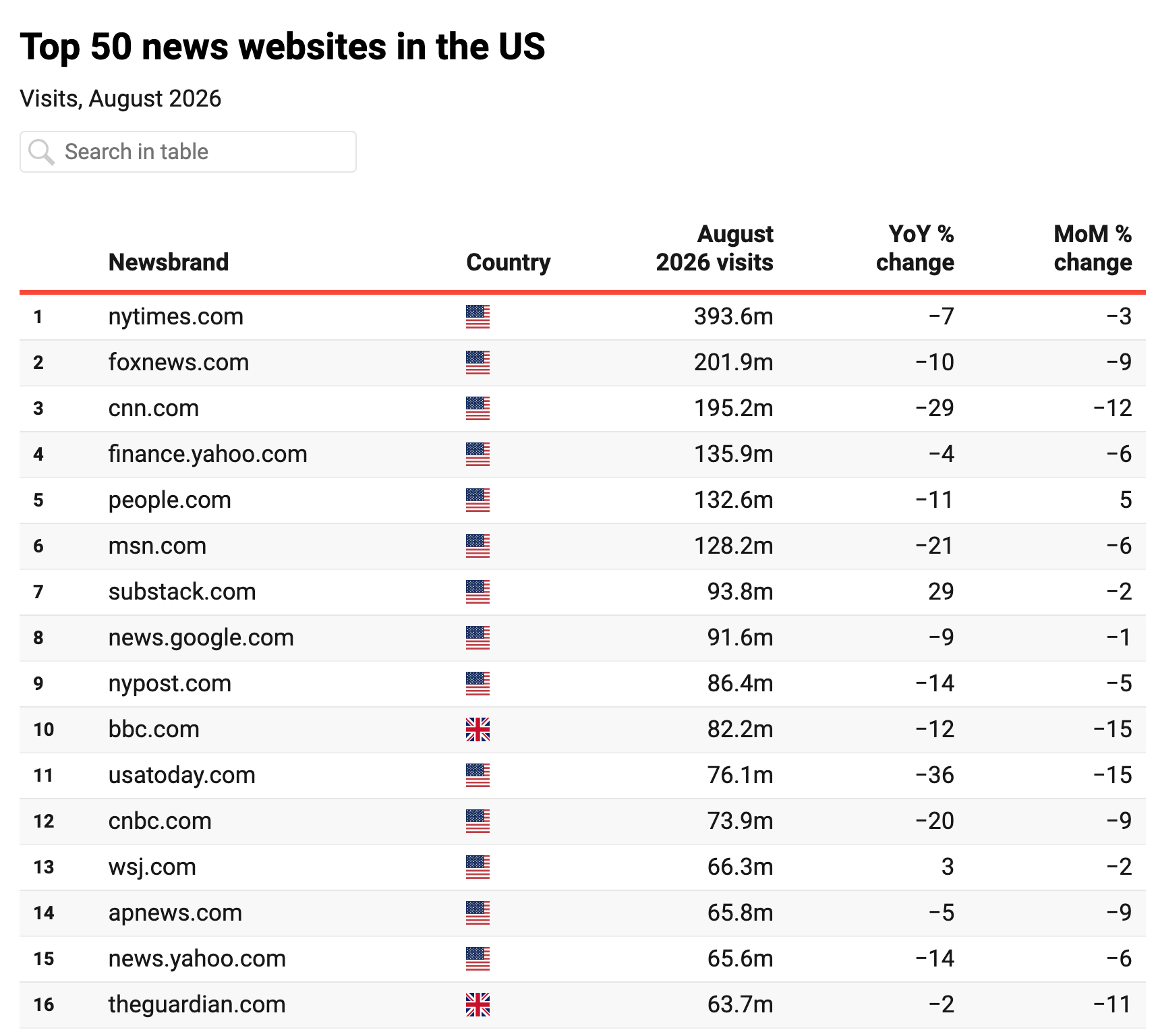
What it means: Many publishers continue to see their traffic decline as they grapple with changes to search results that reduce the need to click. The three sites with significant drops — Newsweek, the Daily Mail and Business Insider — have all announced layoffs in recent years and reorganized audience teams to focus more on building direct audiences.
#SPONSORED - The Classifieds

Get your company in front of more than 14,000 writers, editors and digital marketers working in news and publishing. Sponsor the WTF is SEO? newsletter!
THE JOBS LIST
Audience or SEO jobs in journalism. Want to include a position for promotion? Email us.
The Wall Street Journal is hiring an Director of Direct Audience (New York City, New York).
EVEN MORE RECOMMENDED READING
👑 Clara Soteras: How AI is reshaping search intent — what 2 studies reveal.
🤖 Anu Adegbola: Google is testing exact match Search ads in AI Mode.
🧰 Gianluca Fiorelli and Grant Simmons: Tackling technical debt, query drift, and site architecture for AI search.
🔬 Aleyda Solis: How to measure AI search visibility impact and business success.
🛍️ Similarweb: The state of ecommerce in 2026.
🏢 Steve Toth: I tested and tracked 60 LinkedIn posts ranking in Google and AI Overviews. Here’s what the top performers have in common.
🔗 Bengu Sarica Dincer: When attribution looks more precise than the data behind it.
📉 Cyrus Shepard: The 2026 Google ranking factors: Expert survey [featuring Jessie!].
🤔 Sarah Perez: Meta debuts its Muse AI agent. Will consumers trust it?
💬 Barry Schwartz: Almost all PAA answers are now AI Overviews.
💰 Barry Schwartz: Google Merchant Center AI performance: AI search intent, terms & attribution.
What did you think of this week’s newsletter?
(Click to leave feedback.)
Catch up: Last week’s newsletter


Have something you’d like us to discuss? Send us a note on LinkedIn (Jessie or Shelby) or email us (WTF is SEO? Newsletter).
Written by Jessie Willms and Shelby Blackley