


Hello, and welcome back. Jessie here, back from a week of crushing hockey-related losses for us Canadians — but, also sewing lots on a new quilted jackets project. You win some, you lose some. The good news: both involved snacks and good pals.
This week: A look at Google’s Preferred Sources feature, a clear shift toward personalization on search that also offers publishers an opportunity to build audience loyalty. We explain what it is, how it works and why it’s just a small piece of the audience engagement strategy.
Community call: Thanks to the ~50 people who joined our 2026 winter Community Call! Check out the recording of the call and transcript of the conversation.
#SPONSORED
Last call: Join our paywall masterclass!

Our masterclass on paywalls with Barry Adams (Polemic Digital) and Harry Clarkson-Bennett (Leadership in SEO Substack) is happening soon!
Use the code WTF10 for a discount!
Learn the fundamentals for the technical side of implementing and optimizing a paywall;
Understand how to build a successful commercial strategy for monetizing your site;
Know how to structure, surface and optimize paywalled content to continue to reach search (and other off-platform) audiences.
PLUS: All attendees get access to a private Slack channel with all speakers to ask unlimited questions.
Join us on March 4!
THE 101
What is the Preferred Sources feature?
In August 2025, Google rolled out a new personalization feature for organic search results called Preferred Sources. At the time, Google’s Duncan Osborn called it a way for users to “stay up to date on the latest content from the sites you follow and subscribe to.”
It is a subtle shift toward increased personalization and user-controlled curation in Google’s ecosystem.
Preferred Sources is available globally for English-language search queries that trigger a Top Stories box. It is also only available for domain-level and subdomain-level sites (i.e., newssite.com or canada.newssite.com, but not subfolder (i.e., newssite.com/hockeyblog).
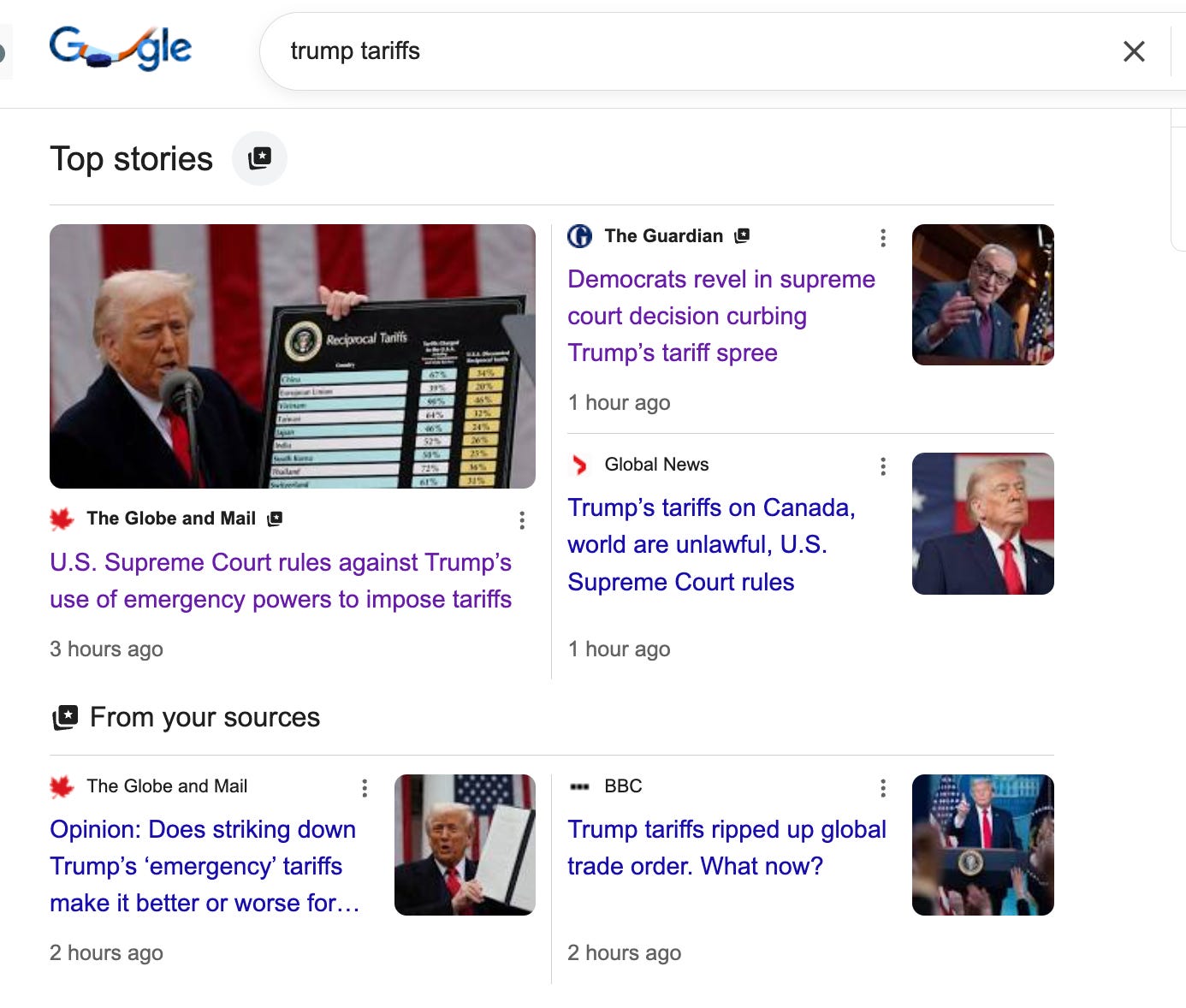
Google will often surface a dedicated “From your Sources” box populated exclusively by websites the user has preferred. Publishers can appear in both the traditional Top Stories box and “From your Sources” on the same query (like below).
Why does Preferred Sources matter?
With the increased visibility of AI on search and zero-click features threatening the ranking opportunities on Google Search, Preferred Sources is a welcome addition to help sites increase their visibility and build audience loyalty.
For users, it’s a way to get more of what they like — and less of what they don’t — on search.
The path to long-term success as a publisher continues to be a focus on building a loyal on-site audience of readers who engage with and actively seek out your content.
Preferred Sources is just one tactic within the broader audience engagement portfolio to build loyalty.
Retention tactics like newsletters, push notifications, regular popular franchises/series episodes, as well as off-site efforts like increasing followers on Apple News, YouTube optimization, or podcasts are all crucial. This is a small but helpful tactic for publishers to employ.
How Preferred Sources works
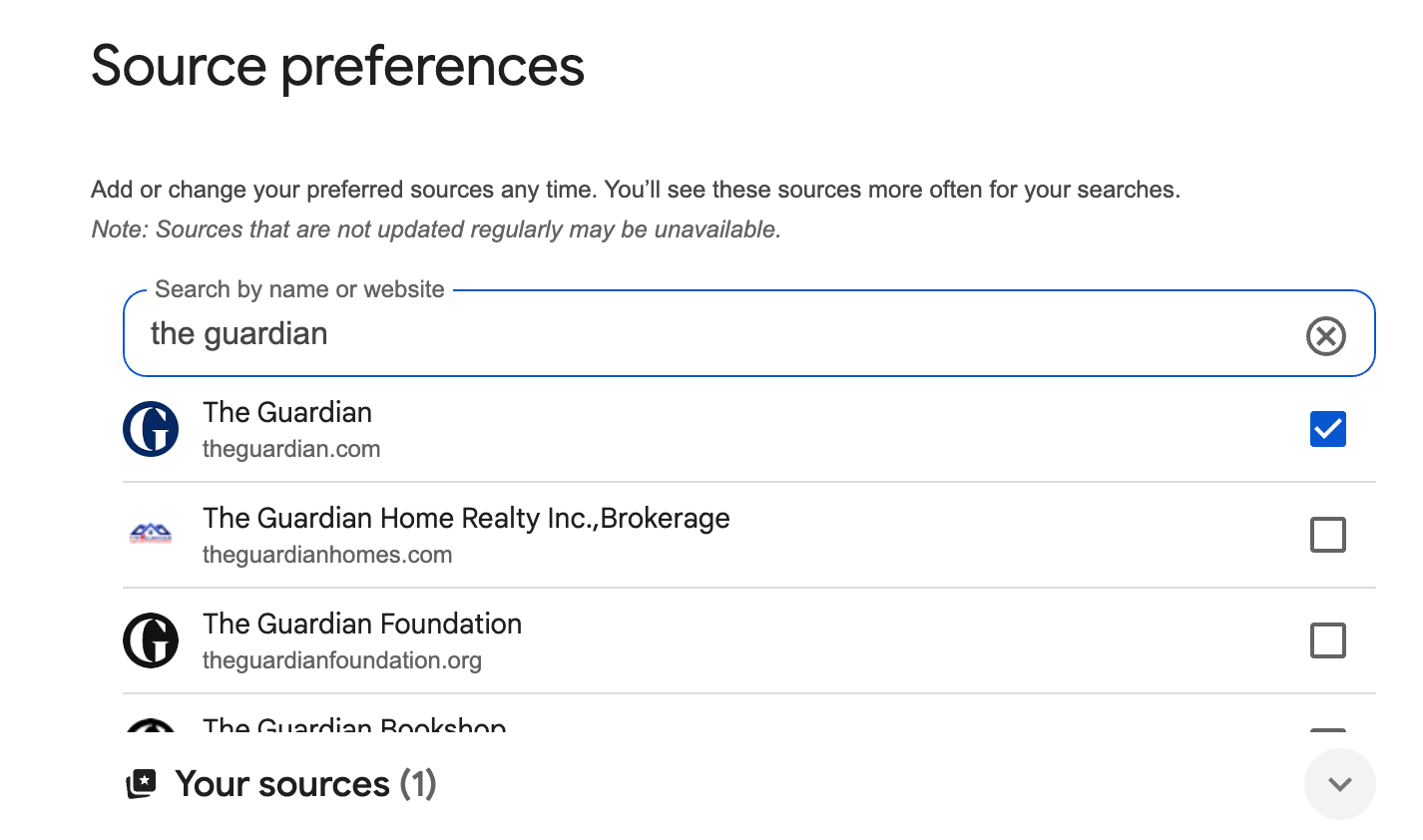
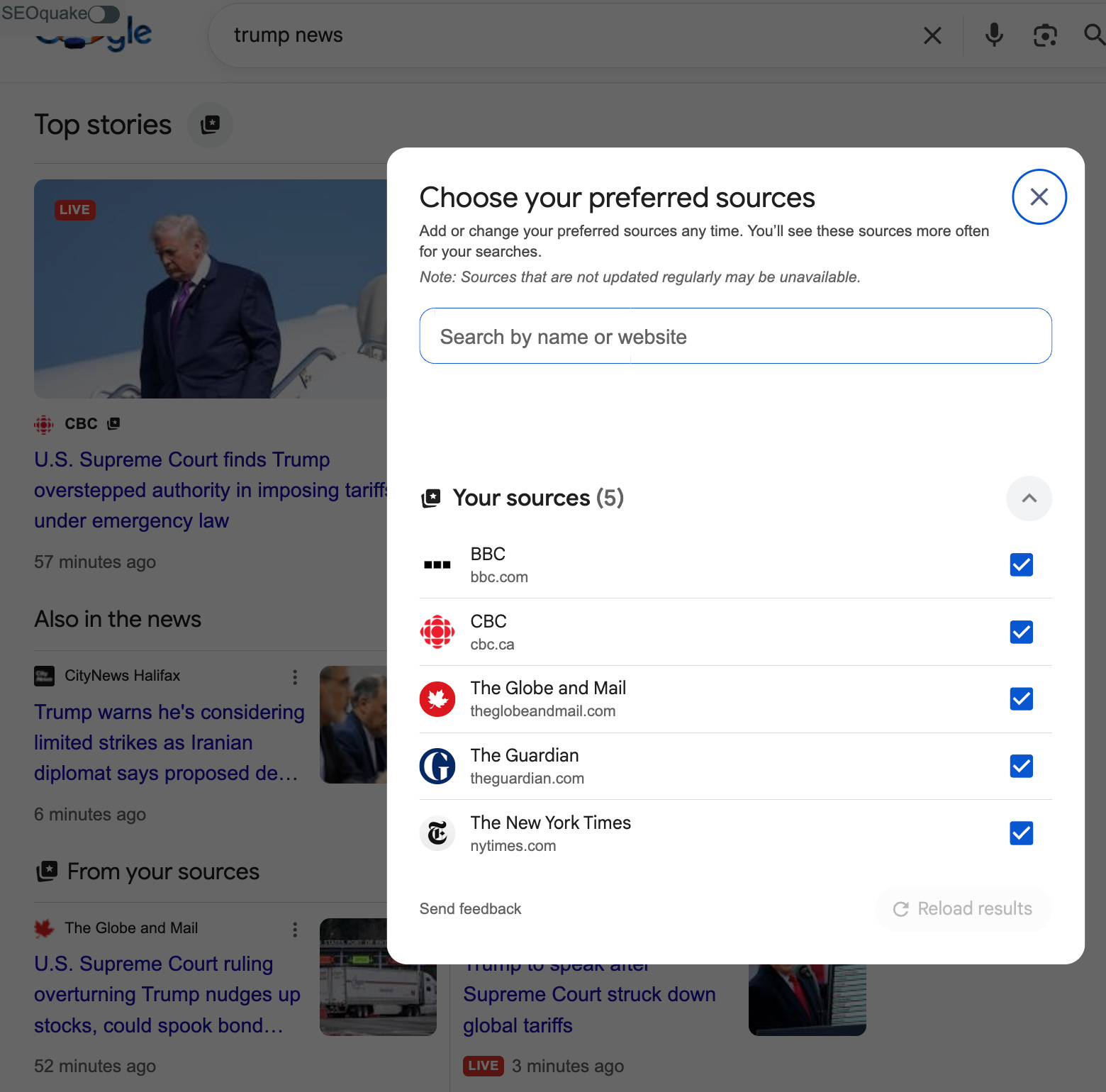
When users select a publication from the “Source preferences” directory, it makes those sites more likely to appear in their Top Stories when it has a page relevant to the query. There’s no limit to the number of sites a user can select, and users will continue to see content from other websites.
Users can also add a source directly from search results, by clicking the icon (next to the Top Stories label) and choosing from the search box.
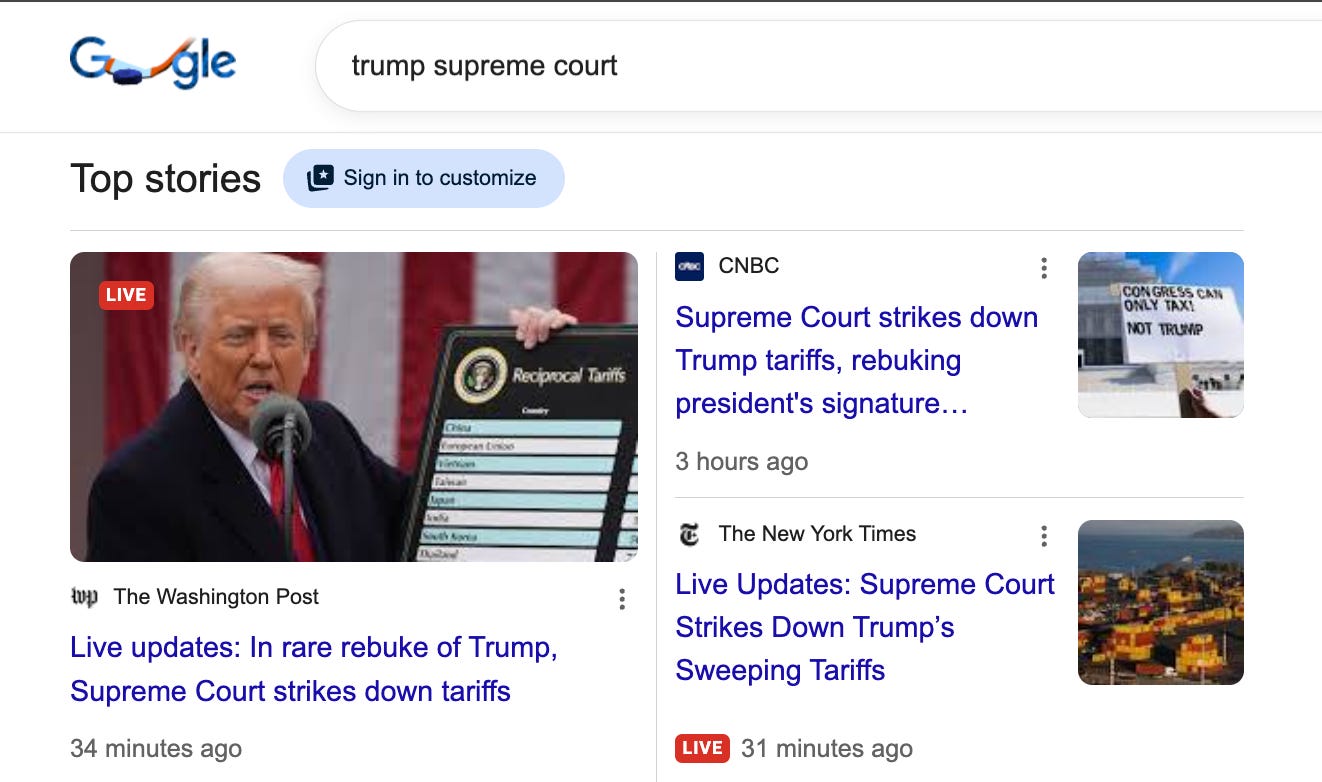
To access the feature, users must be logged in; for logged-out users, there’s a “Sign in to customize” prompt next to the Top Stories label. It appears that ‘Sign in to customize’ language was added earlier this month.
THE 201
What to make of Preferred Sources
To make use of Preferred Sources, the first step is alerting readers to the existence of the feature and encouraging them to add your publication.
This can be done as an article on-site (like the Wired, Guardian and Strategist example below), along with messaging in newsletters and on social media (for example, creating and pinning a post on X, Instagram, Reddit and Bluesky). This promotional content should also include a direct call to action with a link.
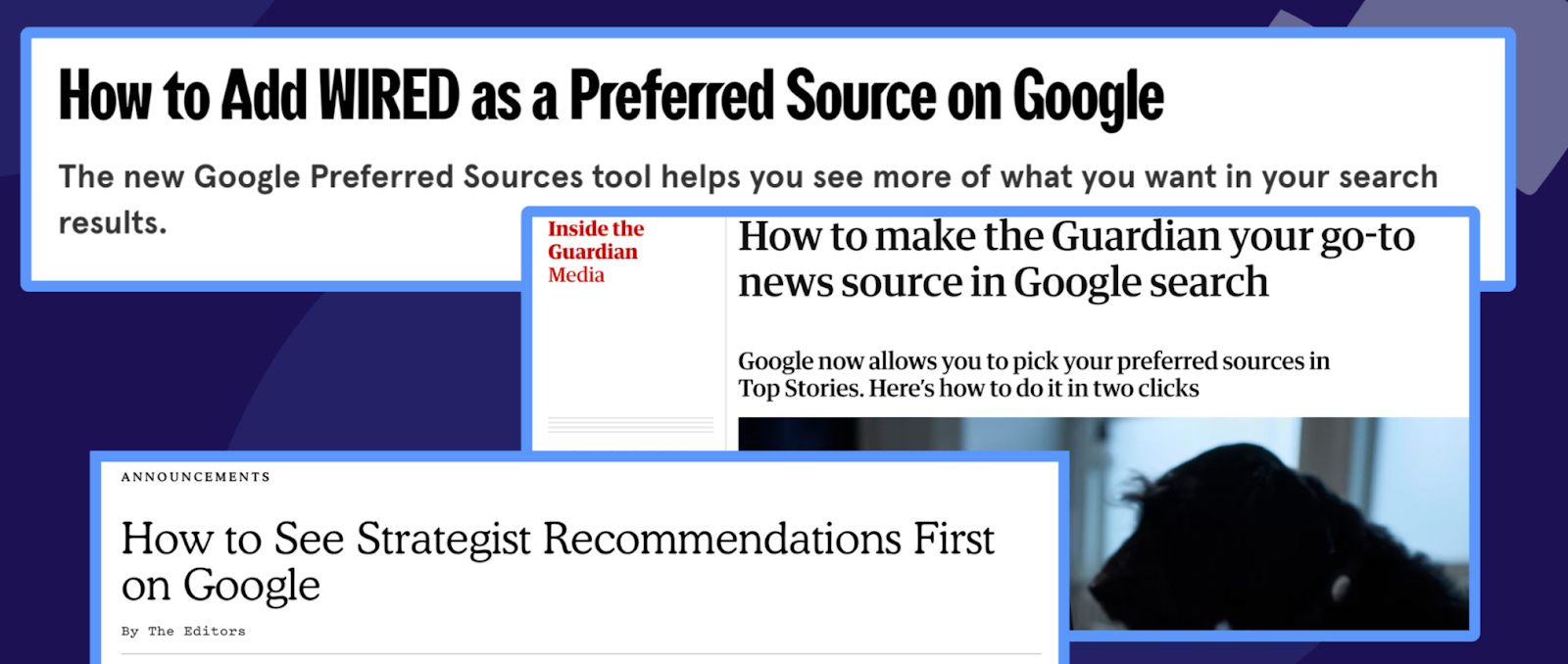
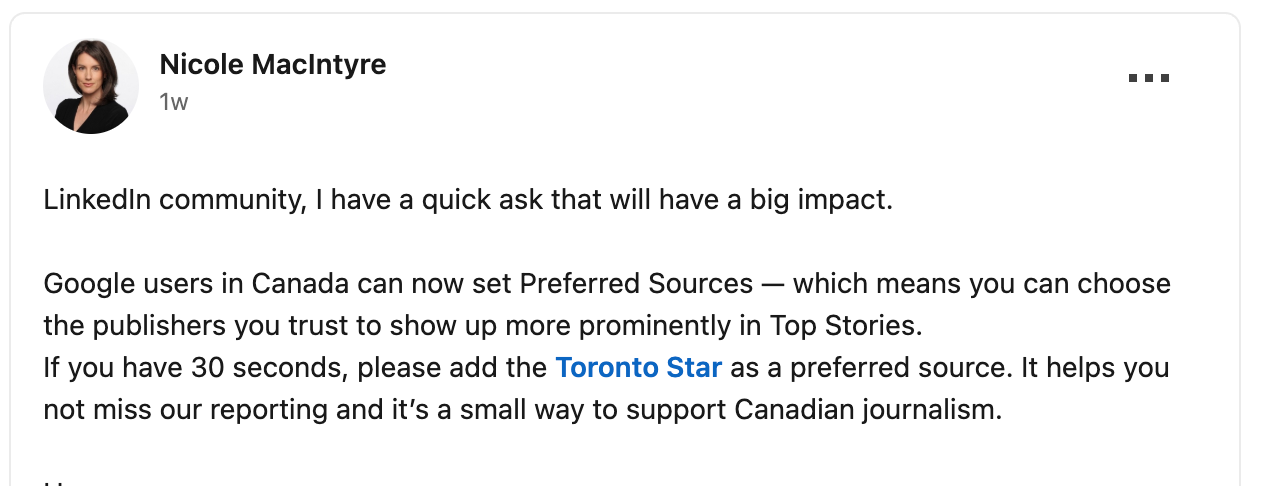
Consider asking known authors — key columnists or top editors — to promote the feature on their own social media platforms, too (as the EIC of the Toronto Star has below).
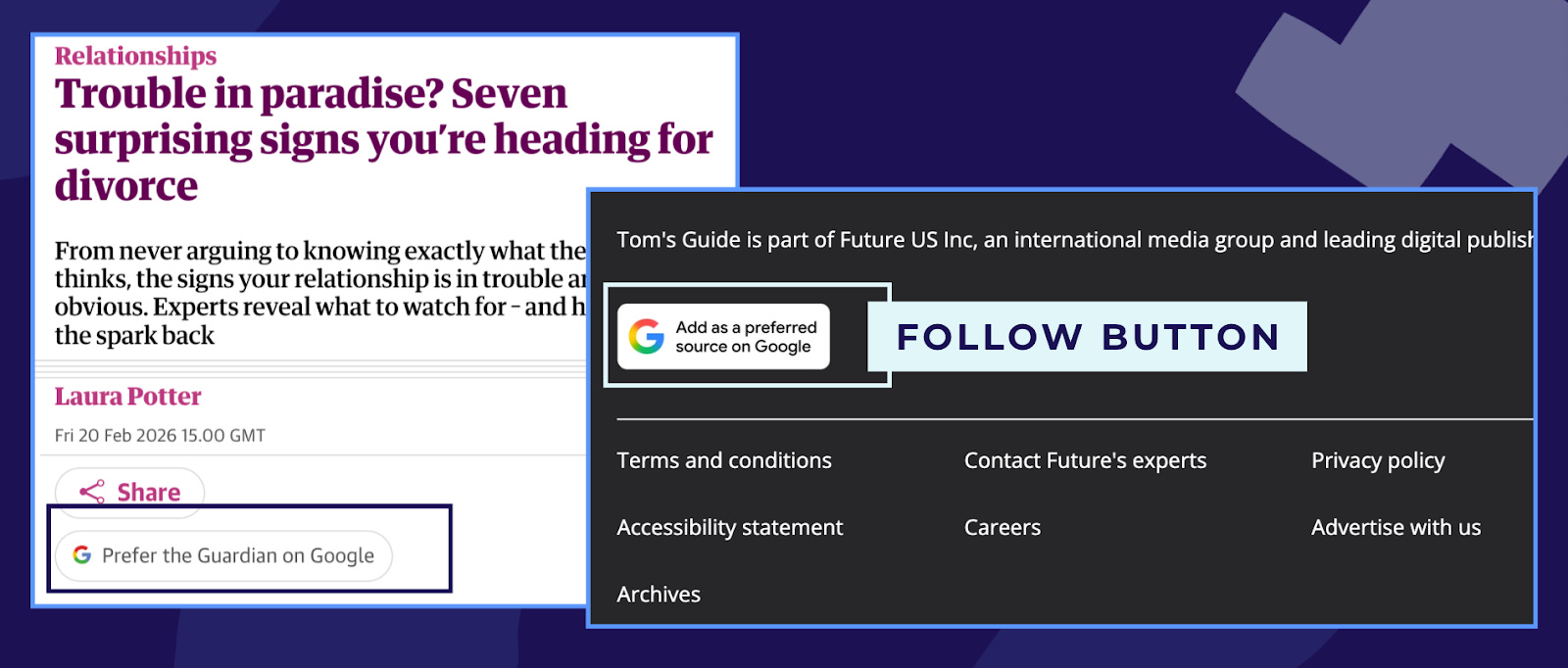
Many websites have also added Add or Follow buttons directly on the article page template. Adding the follow link in the website footer could also be useful.
It’s inconclusive how effective these articles are at converting readers. People are not searching “How to make XSITE my preferred source on Google.” Instead, the primary driver is more likely to be that in-article CTA prompt. Google has guidance on this functionality.
Google has not provided an easy way to track the number of users who currently prefer your website. It’s also not possible to filter in Google Search Console for the number of views that arrived because a user clicked from a preferred site placement.
In August 2025, Google was asked about analytics for the feature. In response, Rajan Patel, the vice-president of engineering for Google Search, said, “We’re looking into this.”
However, sites can track the number of clicks to on-page prompts and articles.
The bottom line: Preferred Sources is an off-site tactic engagement tactic. But ultimately, it is just that: a tactic. Implement it as part of a wider brand- and audience-building strategy which aims to drive loyalty to your publication.
#SPONSORED - The Classifieds
Last call: Sign up for our masterclass on paywalls. On March 4, join our paywall class with Barry Adams (Polemic Digital) and Harry Clarkson-Bennett (Leadership in SEO Substack)!
THE JOBS LIST
Audience or SEO jobs in journalism. Want to include a position for promotion? Email us.
Rumble is hiring an two SEO Editors (Dortmund, Germany).
RECOMMENDED READING
Google news and updates
🤖 Google: Gemini can now create music.
Even more recommended reading
💻 Barry Schwartz: Google Search Console AI-powered configuration rolling out
🔗 Matt G. Southern: Google says links will be more visible in AI Overviews.
❌ Matt Southern: Microsoft summarize with AI buttons are used to poison AI recommendations.
👍 Jojo Furnival: Why your SEO strategy still matters for AI search and what needs to change.
📑 Tomek Rudzki: ChatGPT searches in English even when you don’t.
The study found that 43 per cent of background searches ran in English, even for non-English prompts.
📓 Lily Ray: Are citations in AI search affected?
🤔 Kevin Indig: The science of how AI pays attention.
What did you think of this week’s newsletter?
(Click to leave feedback.)
Catch up: Last week’s newsletter


Have something you’d like us to discuss? Send us a note on Twitter (Jessie or Shelby) or to our email: seoforjournalism@gmail.com.
Written by Jessie Willms and Shelby Blackley