

#SPONSORED
Do you know why ChatGPT isn’t mentioning you?

No more stalling. Receive a deep scan and personalized action plan to start appearing in ChatGPT. Get a weekly list of action items based on which citations are used in your market. Track your progress and see what moves the needle in getting new customers. Used and trusted by 9,200+ marketers!

Hello, and welcome back. Shelby here, finally situated in Canada for an extended time. After a very chaotic fall season filled with so much excitement, grief, travel and lessons, I’m grateful to be hanging out at home for a while. Let’s see how long it lasts!
This week: Nine hacks for your 2026 Winter Olympics SEO strategy. If you’re already thinking about this event, congratulations! It’s likely already taking up most of your mental capacity. If you haven’t thought about this event yet, well… there are still 66 days to go! Let’s get ready.
We’re partnering with Indiegraf for a webinar on AI and what publishers need to know on Dec. 10 at 2 p.m. ET/7 p.m. GMT. Sign up today!

Let’s get it.
THE 101
Nine hacks for your SEO strategy for the 2026 Winter Olympics
The Olympics are a massive tentpole event, and are likely taking a big chunk of resources in your newsroom. Tentpole events — non-breaking, non-daily news that is scheduled in advance and have a set timeframe — rely greatly on planning. Here are nine ways to make the most of the search interest coming up in the Winter Olympics.
1. Establish your organization’s commitment level
Establish how much your publication will invest in the Winter Olympics. This will determine how much energy the audience team needs to contribute, as well.
Ask stakeholders the following questions to gauge investment:
How many writers/editors are we sending?
How many writers/editors will be dedicated to the event remotely?
Are we focusing on our country’s performance, local Olympians or state/province-wide coverage? Are we focusing on multiple countries?
Are there niche topics during the Olympics to cover?
These can be the environment/climate impact, the socioeconomic implications, the geopolitical landscape, etc. (The Olympics are full of angles.)
Which athletes do we care about most/will our audience be most interested in?
Determining the above will help guide how detailed your guidance and recommendations will be. If your newsroom is only planning on writing a few times during the event, your guidance will be more limited than if the company is sending droves of people to Milano Cortina.
From there, you can establish how much the publication realistically can and should publish before and during the Olympics. That could be 5-10 stories per day, stories just on key moments, a live blog each day or a combination thereof.
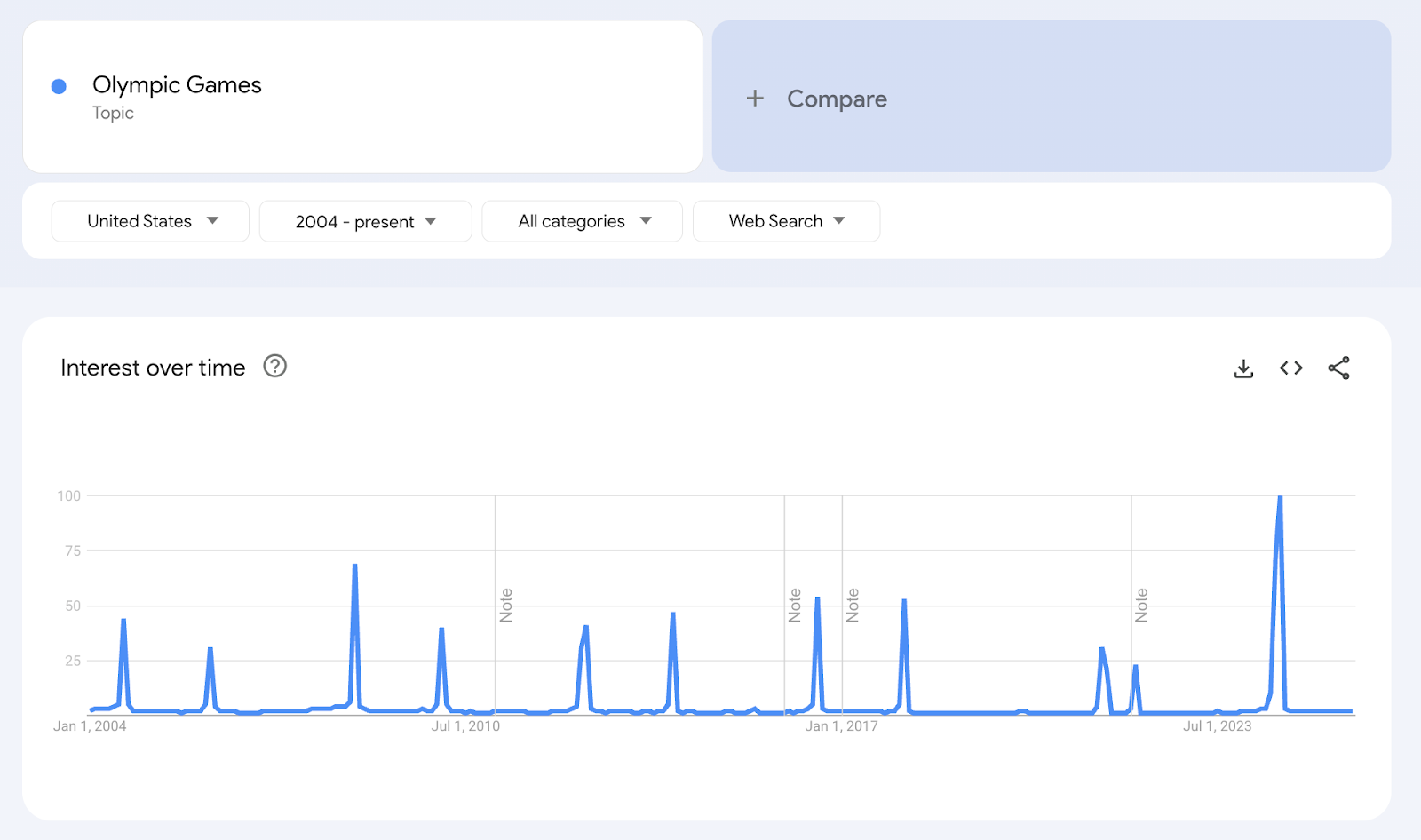
The Olympics are a seasonal event. They occur roughly every two years and follow a lot of the same patterns — audience interest tends to reoccur.
🔗 Read more: We’ve covered the Olympics before, and other SEO strategies to implement.
2. Conduct keyword (and audience) research
Next, review the previous years’ top and rising keywords on Google Trends. Include multiple keyword variations, including the general Olympics topic as well as the Winter and Summer topics. This is great for understanding peoples’ patterns and behaviours for an event of this scale. Use Google Trends to compare the common search terms for your publication’s regional coverage areas too (for example, Canada-wide versus just Saskatchewan).
Focus on topics over keywords. How does your outlet establish topic authority around the Olympics? Are there specific subjects covered regularly that apply to the two-week event?
🔥 Pro tip: Google Trends has a 2026 Winter Olympics topic in its list; follow it for rising and top keywords to build out coverage areas of interest for your publication.
Look at SERPs, too: Search the keywords and topics you want to rank for. Take inventory of what’s showing up, who’s showing up and what people also ask (PAA) questions are being surfaced so you know what ranking opportunities there are and where your content might appear. Also, take stock of what Google features — including AI — are showing up and for which terms.
🚨 Louisa Frahm, SEO director at ESPN, shared incredible tips on Google Trends. Rewatch the video recording or review our slides. 🚨
Create a document with guidance for on-page optimizations. Include:
The main-focus keywords (“Olympics 2026”) and secondary terms to use in headlines, URLs, subheads, linking, etc.;
Athletes: What names are relevant to your coverage area?
They will be searched, especially if they get a medal.
Your country isn’t necessary, but do keyword research around your country and “olympics” to see what returns on SERPs.
You may find a story idea to address later.
Your country’s governing organizations (i.e., Curling Canada, British Bobsleigh & Skeleton Association, USA Hockey) are good to include when writing about policies or social issues.
E.g., in Canada, Hockey Canada will be of high interest after the trial earlier this year.
From there, establish your competitive set, and whether they are national brands or local/niche outlets. Take a look at their websites and their Olympics coverage so far, as well as how prominent it is on the homepage and social media channels.
This competitive set information should also be documented somewhere for your broader team to use and refer to during the Olympics.
3. Create content inventory
Get an understanding of your newsroom’s plans and priorities. Somewhere central — a spreadsheet, Airtable or in your CMS — make note of all stories (published and to be published) for updating and recirculation.
From there, build a wishlist of assets. Should your publication publish a medal tracker or preview a specific hockey player before the event begins? Was there something a competitor already has? Note all explainers, stories and other articles you want, including their headline/URL suggestions and update cadences.
Build them out like pitches and provide the Olympics team (or appropriate editor) as much guidance as possible. Include even how it will help toward their goals.
A few considerations:
Stats: Recaps, medal counts, information about contests, events or matches that are relevant to your audience (don’t write about luge if no one cares in your region!);
People: Human-interest pieces about athletes or behind-the-scenes folks;
Politics: Hard-hitting analysis or investigative journalism on the scandals among governing bodies;
The ‘magic’ moments: Be a bit psychic. Identify these moments as they are happening and have general assignment writers ready to jump on the trend.
4. Topic tag page
Having a prominent Olympic category or tag page will depend on your site structure and level of commitment. But regardless of the type of collection page, ensure the Olympics one is linked prominently in the navigation and — if possible — on the homepage. The homepage provides the strongest signal of subject matter expertise, which you want to identify as soon as possible.
Optimize the <title> and <h1> tags for this page to target the 2026 Winter Olympics and your specified main keywords.
Everything published about the Olympics should be linked to from this page. Consider linking the collection page on first reference of the Olympics in stories, too, to ensure the two-way relationship. The more content found on a tag page the better and will help build the site’s authority ahead of the event.
If you can customize your collection pages, consider adding links to sections or tags that are associated with the Olympics (i.e., if you have a skiing tag, link it from the Olympics page).
5. Determine Live coverage
In the past, live coverage (i.e., live blogs) dominated the Olympics, especially for those general keywords where up-to-date coverage is pertinent. However, not every newsroom is able to be live for every event, and some can only be live for one central blog.
Establish your bandwidth and capacity as soon as possible. It’s hard to capture all of your audience in one live blog, so determine how wide a net you want to cast. Set expectations early.
From there, establish your SEO strategy for the live blog:
Does it have the proper structured data to signal each update?
Establish a linking strategy;
Link intentionally in stories that are related and add to site navigations where possible.
Determine homepage prominence;
If there are multiple lives, determine a strategy for visibility (on the homepage and elsewhere) and headlines to avoid cannibalization.
Give headline guidance during the moment;
Establish an update cadence (i.e., do you want a consistent headline during the Opening Ceremonies, or up-to-date?).
How often does a “rolling” live blog update?
Do you want a fresh URL daily for Google’s query deserves freshness signal?
The Olympics are on CET (Central European Time). Even when it is overnight in Italy, there will be interest across the world. This means live files — and others — need to be at their best at all times.
A rolling file:
Compiles all of the day’s events in one place;
Provides easy links to that day’s coverage as well as links to the broader coverage;
Links to your content hub, which houses all of the information someone may need.
Whether you choose to do a live file is up to your team’s capacity and strategy, but a rolling, updated story should be simple if you’re expecting the Olympics to be a large portion of your job.
🔥 Pro tip: While a rolling file will link out to many pieces of more in-depth reporting, the file itself should still serve some kind of reader intent. The content should be easily digestible and readers should be able to get all the information they need so they can continue on with their day. Keep it concise.
6. Enforce good communication
We very much are team over-communicate. Everyone should know who handles what and where to discuss story ideas, and where to go in breaking news moments.
This Olympics especially, it’s harder to have a main base; Milano Cortina’s locations for some events are up to four hours apart. Ensuring proper communication is crucial to win the event.
Work with stakeholders to determine the following:
Where should most communication occur?
Is there a specific Slack channel, or multiple for designated events/locations?
Who are the main editors/stakeholders for specific coverage/locations?
What reporting needs to be done? What is the cadence? (Daily, every other day, weekly, etc.)
Who needs to know about these reports?
If/when there is a change in guidance, where should you communicate it?
Where can you share daily wins or reinforce positive behaviour/learnings?
Success for planned news events happens when newsrooms over-communicate. As audience editors, we should reinforce what’s working and how it helps our coverage daily. Daily Olympics-specific notes identifies areas to win immediately and keeps up morale for those in the deep trenches. It’s a marathon, not a sprint!
7. Technical audit and considerations
Conduct a technical audit of your site well in advance of the Olympics, ensuring the infrastructure can handle a (likely) spike in traffic from the event. Work closely with your engineering teams to protect the site from going down during the Olympics and that it is capable of handling any “fun” formats (i.e., an interactive that requires more server bandwidth).
From there, ensure the following:
Are all pages crawlable and indexable by Google?
Are there any glaring issues in Google Search Console that need to be attended to?
Are all desired links followable?
Is there proper Schema on live blogs and articles?
Is there proper structured data for your authors highlighting where they are located during the event?
🔥 Pro tip: Read through Barry Adams’ robust newsletter for all technical necessities.
8. Determine metrics and measures of success
Much of this will likely be determined by people who make more money than you. It’s important you know and communicate the metrics that are of focus to your publication’s senior leadership.
If there are specific audience goals — you want to grow newsletter open rate by X per cent or you’d like to increase visibility on search from the Summer Olympics to X per cent — note those, too. Make sure everyone is aware of the metrics of success.
Some to consider:
Did we reach a certain threshold of unique page views? Is it higher than the Summer Olympics?
Is time spent (or engagement rate) higher than average?
How many subscribers did you convert from Olympics-related coverage?
How much traffic arrived from search as a percentage of overall visits?
Did we jump on major news quicker than usual?
Did we build our newsletter audience?
These will help you interpret what success means in a major event like the Olympics, where almost every organization is fighting for the same shrinking space.
9. Have fun
Whether you’re in Milano Cortina or sitting in the comfort of your home, the Olympics are so much fun to cover. Enjoy the crazy moments that you cannot predict and the camaraderie of being in a newsroom working on the biggest story of the event. And don’t forget to order yourself some newsroom pizza.
The bottom line: Big planned news events like this are, truly, audience editors’ Olympics. We’ll be in the story more than many people in the newsroom, so it’s crucial to ensure early planning and consistent coverage. Make it count to serve your audience what they want to know as your country competes.
#SPONSORED - The Classifieds

Get your company in front of more than 13,500 writers, editors and digital marketers working in news and publishing. Sponsor the WTF is SEO? newsletter!
THE JOBS LIST
Audience or SEO jobs in journalism. Want to include a position for promotion? Email us.
The Associated Press is hiring an Audience Data Strategist (New York, N.Y., hybrid).
CBC News is hiring a YouTube Coordinating Producer (Toronto, Canada).
Politico is hiring an Audience Editor (Arlington, V.A.).
RECOMMENDED READING
Google news and updates
🤖 Barry Schwartz: Google says rewriting AI content with human content will not lead to recovery.
🤖 Barry Schwartz: Google says SEO/SEM need to coevolve with search (and SEO is not dead!).
Even more recommended reading
🦁 Kevin Indig: The Alpha is not LLM monitoring.
📈 Stefan Mustieles: What happens when you delete over 50 per cent of a website’s content?
👓 Nikki Lam: Beyond SERP visibility: 7 success criteria for organic search in 2026.
0️⃣ Curtis Weyant: Measuring zero-click search: Visibility-first SEO for AI results.
📄 Ross Simmonds: Navigating content marketing amidst the rise of AI [Whiteboard Friday].
What did you think of this week’s newsletter?
(Click to leave feedback.)
Catch up: Last week’s newsletter


Have something you’d like us to discuss? Send us a note on Twitter (Jessie or Shelby) or to our email: seoforjournalism@gmail.com.
Written by Jessie Willms and Shelby Blackley