


Hello, and welcome back. Jessie here, back from a weekend spent sewing a tree skirt for my Christmas tree! It’s quilted, it’s cute, it’s entirely made from thrifted fabrics — and I only had to redo the bias tape finishing a million times!
This week: How to create non-commodity content! Building on last week’s newsletter and our webinar with the wonderful Louisa Frahm, we’ve got more tips to actually create content that’s unique, distinct, and gives readers reason to visit your site.
🚨 The full recording for last week’s webinar on non-commodity content (in partnership with Trisolute News Dashboard) is now available. Watch it here.

Let’s get it.
THE 101
What is non-commodity content?
What is it: Non-commodity content is built upon first-hand experience, original reporting and specialized expertise. It is distinctive, authentic and has a unique perspective or point of view.
As outlined in last week’s newsletter (and at our recent webinar), commodity content is the opposite — generic, easily synthesized information that provides very surface-level value. Non-commodity content moves beyond the generic and adds original insights. This is journalism that adds something new to the web, making it hard to copy.
In the AI era, surface-level commodity content (i.e., “10 tips for buying running shoes”) has never been easier to produce. It is also easily summarized and replaced by Google’s AI Overviews, chatbots and LLMs.
For publishers to win in the AI era, they must build direct, meaningful relationships with loyal audiences. This is done through non-commodity content: original, human-centric journalism that AI cannot replicate.
Why it matters
Publishers leaned into commodity content for years — because it worked. Sites could scale basic content (“What time is the Super Bowl?”) and see good return on investment, in part thanks to programmatic ads. Google’s systems often rewarded this content with consistent traffic, making it hard to move away from.
However, Google’s recent slew of core and spam updates (including the current ongoing November 2026 update) have targeted and penalized this approach.
It’s clear Google wants less of this content — and is happy to penalize sites that continue to produce it en masse.
Do less, better
Publishers should focus on doing less, but doing it much, much better. SEO expert Glenn Gabe has outlined the problem of “Mt. AI”, where a website publishes a massive volume of AI-content, is briefly rewarded, then ultimately penalized by Google, dragging down the entire performance.
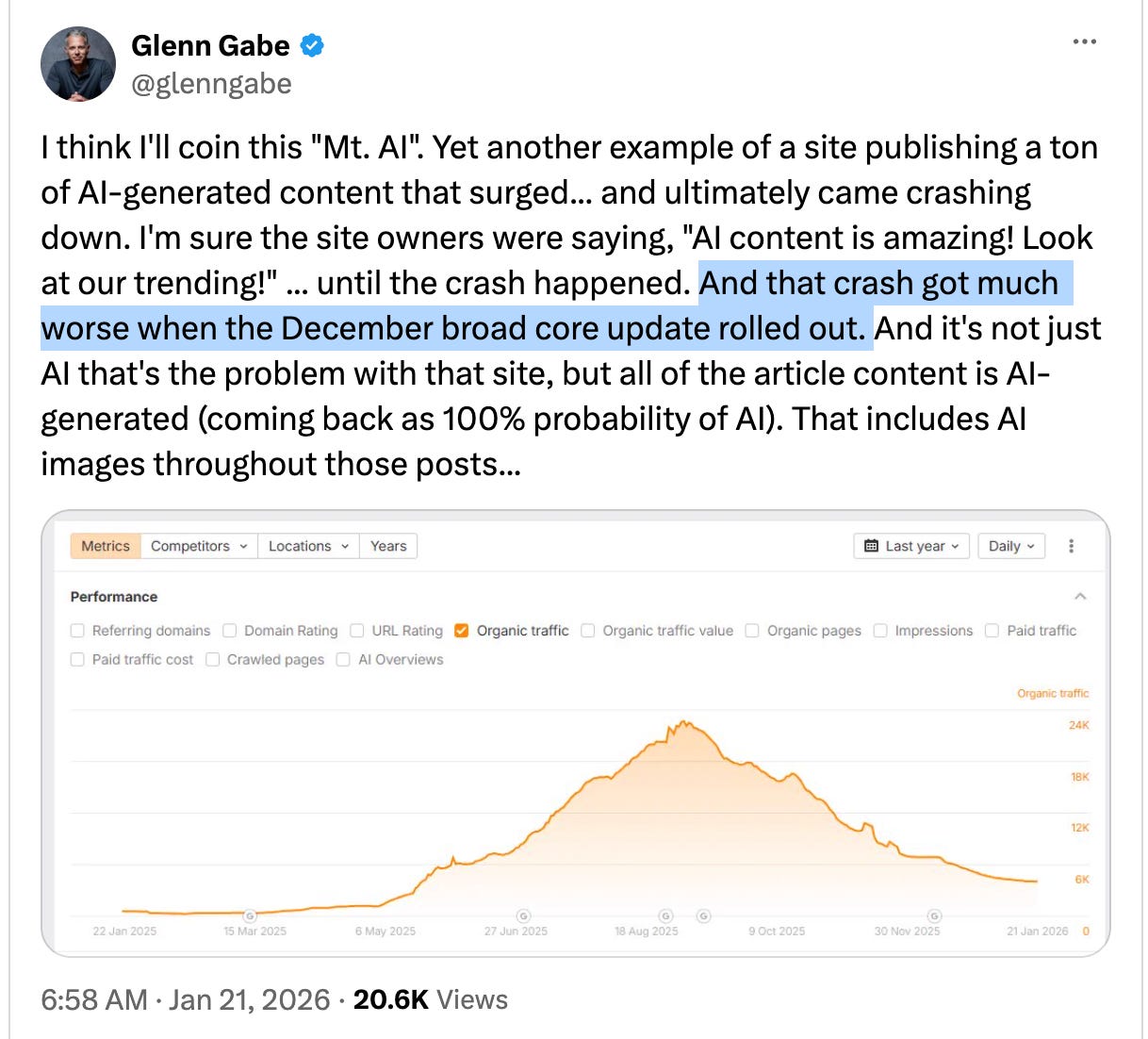
By doing less, publishers can do it better for their real, human readers. Brands should first understand their unique value — user research is helpful for this — to know what makes them different from their competitors.
THE HOW TO
How to build non-commodity content
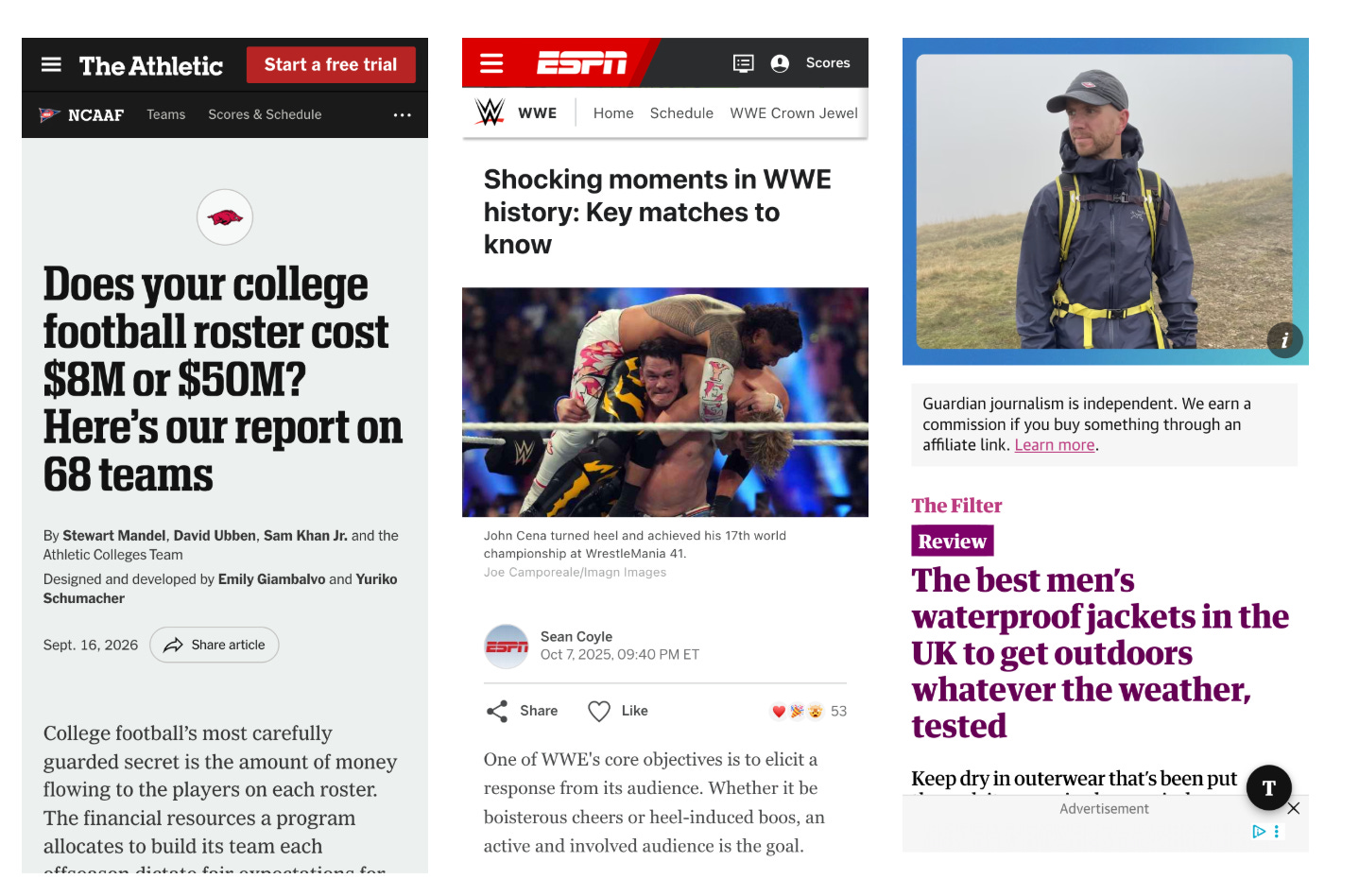
Google’s documentation on AI search is clear about what makes good non-commodity content. Building on the recommendations of Harry Clarkson-Bennett, who has written widely on the topic, these are three central pillars of non-commodity content:
Be unique: Have a distinctive point of view, original reporting or first-party data that cannot easily be replicated. For example, for its report on college football roster costs, The Athletic interviewed more than 70 sources to build its own dataset. This data is nearly impossible to replicate, can be expanded and serves as the foundation for future reporting. To build a guide to the best indie rock albums of all time, Pitchfork first interviewed more than 30 artists, labels and critics to first define the genre — work that no AI can mimic.
Be specific: Move away from broad, generic content that targets high-volume search terms to granular, targeted angles that reflect your audience’s interests. Journalism that is unique is also more share-worthy.
Be authentic: Demonstrate genuine, first-hand experience that reflects E.E.A.T (experience, expertise, authoritativeness and trustworthiness) signals. This is about showing, not telling: use original images and videos, real-world reporting and transparent methodology. In its review of the best waterproof jackets, The Guardian skipped generic product or AI-created images, using instead a photo of the writer testing the outwear’s waterproof claims in the shower. (If you do use AI, be very, very clear about it.)
“It starts with knowing who you are as a brand, determining what you can uniquely offer and understanding how your audience’s needs are evolving,” Louisa Frahm, SEO consultant and lecturer, explained in our non-commodity content webinar.
Knowing what people come specifically to your publication for is essential — and should inform your approach to stories.
Focus on the following three tactics:
Answering timely questions through traditional search and audience work. Using Google Trends or social listening can help uncover questions readers are asking. This work still matters. Editors should look for gaps in coverage to provide the newsroom angles they can respond to with authority and expertise.
Context is everything. To deepen coverage, include analysis and commentary that respond to your audience’s unique needs.
Give readers a good reason to return to your site. Distinctive coverage makes you stand out. Provide something your competitor can’t.
Even if your publication is covering a broad topic, find your distinct voice, Louisa says. “We really need to be more targeted in the stories that we’re going after — and zone in what your site can specifically own.”
For example, the Olympics are covered by nearly every publisher in the world. While many brands cover the same storylines, there’s room to be different. Provide context or information other sites miss (or don’t have the expertise to cover).
Being distinctive and creating great content doesn’t require publishers to abandon quick-turn pieces, evergreen explainers or content that answers questions readers are asking on search. Stories that cover important news events or milestones can still perform well when anchored within your publication’s established authority.
Focusing on what your publisher does better than any other site (or any AI model) is the key to long-term success with non-commodity content. As Harry says, "For the love of god, just make somebody feel something.”
The bottom line: Be distinctive, unique and authoritative. That’s the secret to creating the kind of non-commodity content that provides a value to your readers and that Google says it wants.
#SPONSORED - The Classifieds

Get your company in front of more than 14,000 writers, editors and digital marketers working in news and publishing. Sponsor the WTF is SEO? newsletter!
RECOMMENDED READING
Google news and updates
🤖 Google Search Central: New filtering and reporting capabilities in the search analytics API.
Even more recommended reading
🧭 Harry Clarkson-Bennett: How I’m approaching AI search.
🤝 Lily Ray: Why building trust through real people stands the test of time in SEO and AI search.
📊 Barry Schwartz: Google Search rolls out AI Mode sidebar.
🕷️ Barry Schwartz: Google Search help document on how to allow Google-agent traffic.
🕵️ Derek Perkins: Is Google killing incognito searches?
📶 RESONEO: Google’s 300 ranking signals, and the fifty that apply to your page.
🧠 Dan Petrovic: Google’s AI mode model knows little on its own and answers from what organic search supplies
⭐ Gus Pelogia: A guide to Google’s Preferred Sources: How to get instant visibility into AI Mode.
What did you think of this week’s newsletter?
(Click to leave feedback.)
Catch up: Last week’s newsletter


Have something you’d like us to discuss? Send us a note on LinkedIn (Jessie or Shelby) or email us (WTF is SEO? Newsletter).
Written by Jessie Willms and Shelby Blackley