


Hello, and welcome back. Shelby here, back from the sunniest of sunny weekends in Toronto. It was a social one for me: I started the weekend on a gorgeous patio overlooking the CN Tower with far too many margaritas, spent Saturday playing a fun game of softball (with Jessie!) before taking in two horror films Sunday. Mix in some reading (Hayden Panettiere’s memoir is amazing) and watching Remember the Titans, and I’d call that the perfect weekend.
This week: 7 tips to prepare for the World Cup. Yes, we are just nine days out from one of the biggest global events in sports. While it is a sporting event, the World Cup also encompasses geopolitical tensions, protests, climate impact, municipal infrastructure and much more. Every publisher has an opportunity to be involved. We cover final essentials to keep in mind.
🎉 Heads up: We’re hosting a webinar in partnership with Marfeel on June 22th, on what to do about AI. Stay tuned for more details.
Let’s get it.
THE 101
Preparing for a tentpole event in 2026
Since the last World Cup four years ago, a lot has changed on Google Search. The rise of AI in (and around) results, along with expanded SERP features (like scores, stats, lineups, etc.) on sports queries makes predicting this year’s return from search traffic even more challenging. It’s incredibly important to set that expectation.
Tactics that resulted in massive traffic four years ago might not convert this year. News SEOs and audience editors need to be clear: nothing is guaranteed.
Google also concluded rolling out the May 2026 core algorithm update today (literally Tuesday morning!), which lasted 12 days and 21 hours. This update appears to be highly volatile already, with signs Google is preparing for a surge in users.
The Top Stories box for queries like world cup 2026 and world cup have already shifted further down the page, sitting below Google-owned features like the schedule and standings, predictions and more (see below). Additionally, there are multiple “what people are saying” boxes, which curate user-generated content from YouTube, X, Reddit, Instagram and more.
Data from Trisolute News Dashboard also shows that the FIFA World Cup host cities sites (nynjfwc26.com, kansascityfwc26.com, atlantafwc26.com, etc.) are ranking well on desktop and mobile SERPs for most competitive world cup keywords. That visibility indicates Google is leaning on local, authoritative sites.
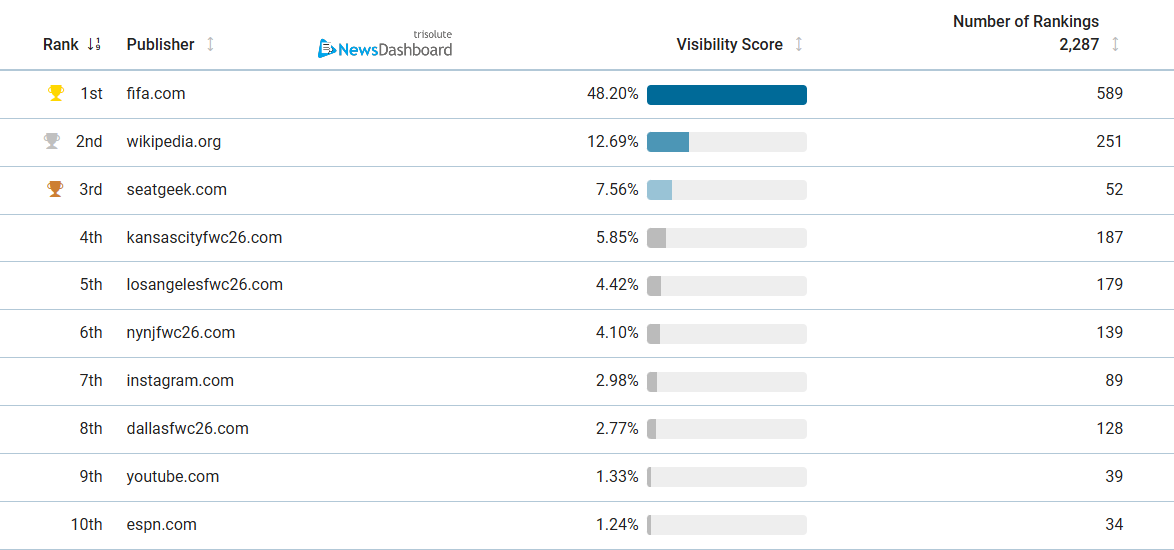
The TL;DR: Google is currently shifting results pages for prized keywords, putting an emphasis on owned features and authoritative sites (read: topic authority). Publishers need to lean into their niches and reputable authors. Don’t chase trends.
THE HOW TO
7 winning tips for World Cup success
Everything we do rests on a solid SEO foundation: strong technical hygiene, quality content within your topical focus and good optimization. This is still the priority.
Let’s discuss other tips to winning.
1. Audit and prepare
Let’s be honest: a successful World Cup strategy began months ago.
Harsh? Maybe. But audience and SEO editors know our work starts long before the event.
If you’re starting now, here’s what you can still do:
World Cup hub: Every tentpole event should have a hub (category or tag page) that links all of the coverage — stories, along with key team or match pages and interactives — together. It should be linked prominently from your homepage.
Guides and evergreen coverage: The value of these pieces may have changed, but they can still be vital to readers. Stories around
World Cup 2026 datesorhow to buy last minute ticketsshould be published ahead of the tournament, and updated as necessary.Establish SEO foundations: Pre-write as many headline and URLs as possible. Headlines can always be adapted based on trends of the tournament, but giving teams a basic formula speeds up the process.
Make a list of the “main” pieces: Create a list of these pillars — interactives, brackets, schedules, guides, etc. — for editorial teams to streamline the linking process.
Make a list of keywords to track: Keywords are still the main way people find information on Search. Use Google Trends, Glimpse or another keyword tool to list and track the essential keywords for your publication during the tournament.
2. The new Search reality: AI Overviews and chatbots
AI Overviews didn’t exist during the last World Cup, and AI’s visibility on SERPs has grown even since the Olympics in February. The emergence of AI completely reshapes how fans will find top-of-the-funnel informational queries like how many teams are in the world cup?
In fact, on SERPs right now, an AI Overview answers that question.
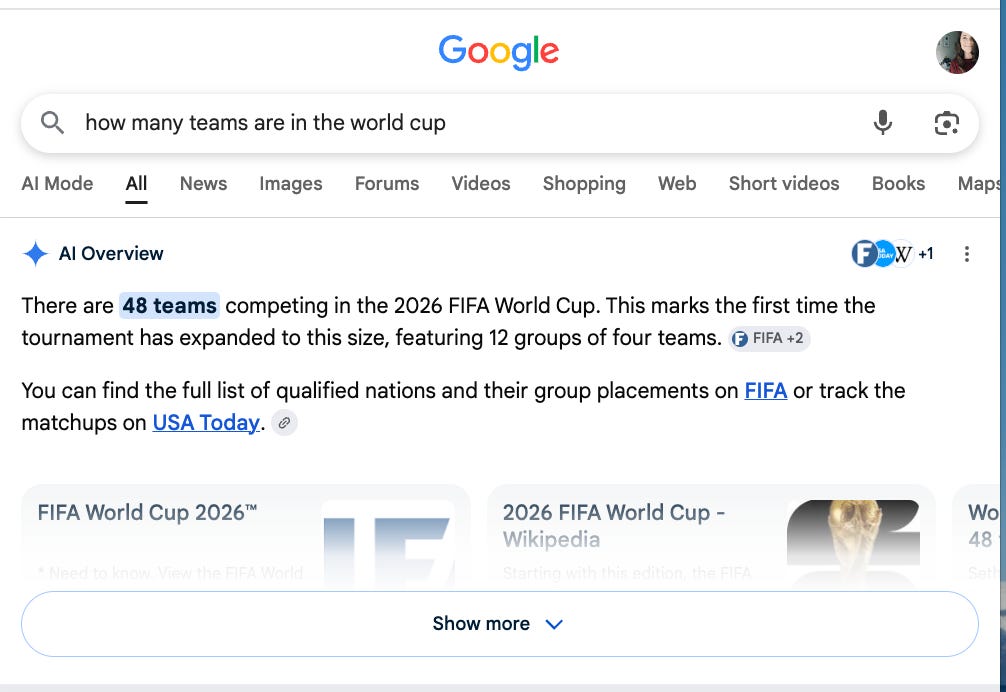
Instead of ranking for queries AI can easily summarize, focus on highly specific analysis and opinion that is context rich.
This means tactical breakdowns, emotional narrative stories, political commentary and investigations that drive the conversation. This is the crux of E.E.A.T: covering games with a human eye.
This World Cup will also be extremely multimodal. It’s a heavily visual event, so consider how video and imagery fits into your coverage. The growing visibility of YouTube, Reddit and TikTok suggests there will be more UGC — find a way to fit into the conversation.
The fundamentals of technical SEO are extremely important. It also helps with AI citations, so Google can properly attribute the information (when it does…). Ensure you are using clear structured data for the games (SportsEvent), authorship, live blogs and articles, highlighting exactly where reporters are writing from. This is critical. On-the-ground, live coverage can’t be replicated by a robot in real time.

3. Track everything
Knowledge is power. Stakeholders are keenly interested in how Google is changing, and what you’re seeing during the tournament means for future projections. The more data, context and insights you can provide in real-time the better.
Competitor analysis: Audit who is showing up in the top results and what media (video, tables, quotes, audio).
AI analysis: Try a variety of prompts in chatbot and AI Mode to understand how the robots talk about the World Cup.
Key performance metrics: Set up trackers for your main KPIs (like keyword clicks, page ranking or positioning, etc.).
SERPs analysis: What features are Google showing? How often are there other features? How low down is the Top Stories carousel? How many “What people are saying” boxes are there? Is there an AI summary? How many non-publishers are featured?
4. Keep the newsroom in the loop
An effective search strategy requires strong, seamless, consistent communication, as championed by The Athletic’s Ryan Mayer. Communicate too much and too often. Over-communication is how you take SEO from afterthought to front of mind in a newsroom.
Build 360-degree feedback loops between the audience/SEO team, the World Cup team and the live team, so reporters can know precisely which player angles, storylines are spiking in search interest. Provide guidance on when to publish and whether a story may be useful on another platform, like Reddit or YouTube, because that’s actually showing up on Google. Knowing what the internet is talking about can help reporters in a scrum, or editors working on getting news out fast.
Other considerations to help the newsroom:
Real-time Slack/communication channels: Set up dedicated channels for the Search team and live teams to communicate headlines, trends, etc.
Daily workflow audits: This can be a short Slack message or an email. Communicate what is and isn’t working, so the plan for the next day can be tweaked.
Plan in advance: Audience editors know when things will pop off. If a certain player is of interest and there’s a previous feature, get it ready just in case he’s mentioned on a broadcast. This “psychic” sense helps editors more than you know.
Ultimately, your job as an audience editor is to help the reporters cover all of the angles that build their authority. Find ways to help make this easier.

5. Winning on Google Discover and multimodal search
Google Discover and visual search features are predicted to be more of the traffic share throughout the tournament. Discover is leaning into multimodal, local and live coverage, so ensure to optimize headlines to strong, engaging and emotionally resonate. Avoid clickbait, but lean into the curiosity gap and emotional stakes of the story.
A multimodal content strategy will be pivotal to success. Video is already featured heavily on Google. If you’re publishing video or audio (and you should), ensure your assets are indexable with structured data and transcribed accurately.
Other considerations:
Discover image optimization: Include descriptive alt-text, vibrant imagery at a minimum 1200px wide with max-image-preview:large setting.
Video SEO integration: Ensure YouTube or self-hosted videos include strict timestamps, VideoElement schema and descriptive transcripts.
Tracking Discover success: Utilize Google Search Console to differentiate regular organic traffic from sudden Discover spikes to replicate winning formats for other coverage (i.e., is it a specific headline format? Topic? Writer?).
6. Live blogs and breaking news: Speed is (still) king
AI cannot replicate live, in-the-moment coverage. During breaking news and matches, it comes down to the people providing that analysis for context.
With more than 100 matches and breaking news we cannot predict, there’s no shortage of opportunities to be in the moment. If you are going to be producing a live blog, it is essential to have clean LiveBlogPosting structured data. This ensures Google sees your updates instantly, maintains fresh timestamps and increases your chances of maintaining the LIVE badge.
Cycle your headlines. All elements of a live-updating page should reflect that. Breaking news should be almost a live entity as you funnel in updates. Stay relevant to what the reader wants, even if Google is not always seeing the changes.
Remember: The first 15-30 minutes post-breaking news are the most critical. Publish fast, update often and provide the context, analysis or insights that no other publication can. This will help foster the engagement signals to keep your coverage in Top Stories longer.
7. It’s not just about Google.
Hot take: Google isn’t the only player in the game. It controls the lion’s share of the market, but Bing’s is on the move. Bing grew from 3.89 per cent market share in April 2025 to 4.98 per cent in May 2026.
As well, search interest on Google for “google alternative” has steadily gone up in the last 12 months.
Keep an open mind to other search engines. Look at how they’re surfacing information. Knowledge is power.
The bottom line: The World Cup event is an incredible opportunity to showcase your expertise and analyze the search engine environment, bringing sharp insights to your leadership teams. Work with your newsroom and capitalize on moments that AI cannot replicate.
#SPONSORED - The Classifieds

Get your company in front of more than 14,000 writers, editors and digital marketers working in news and publishing. Sponsor the WTF is SEO? newsletter!
THE JOBS LIST
Audience or SEO jobs in journalism. Want to include a position for promotion? Email us.
Indiegraf is hiring a full-time Partnership Lead, Enterprise and Programs (remote, Canada or U.S.).
MinnPost is hiring an Audience Development Editor (Minneapolis, Minnesota).
NBCUniversal is hiring a Senior Manager, Web Strategy (specific applications for New York and Los Angeles applicants.
The Athletic is hiring a Head of Social & Off-Platform Growth (remote, U.S. or U.K.).
RECOMMENDED READING
Google news and updates
🤖 Google: New ways to find your favourite sources and original content in AI Search.
🤖 Barry Schwartz: Google strongly warns against manipulating mentions for AI.
🤖 Barry Schwartz: Google says Search Quality Rater Guidelines are not a guide for search rankings.
🤖 Danny Goodwin: Sundar Pichai says Google Search, AI agents and tools will become one.
Even more recommended reading
👀 Matt Southern: Reddit CEO says LLMs ‘would not exist’ without Reddit data.
📈 Steve Paine: May 2026 core update: Visibility analysis and data updates (still rolling out).
⚡ Katie Kirchner: 19 ways to diagnose a decline in organic traffic.
🔍 Aleyda Solis: AI traffic vs AI citations: What clicks and cited pages show about the AI Search journey.
🤖 Daniel Foley Carter: I tested Claude SEO agents so you don’t have to.
👱 Kevin Indig: Users behave differently in AI Overviews vs AI Mode.
🧪 Rand Fishkin: Inimitable product is the new ‘make great content.’
What did you think of this week’s newsletter?
(Click to leave feedback.)
Catch up: Last week’s newsletter


Have something you’d like us to discuss? Send us a note on Twitter (Jessie or Shelby) or to our email: seoforjournalism@gmail.com.
Written by Jessie Willms and Shelby Blackley