


Hello, and welcome back. Jessie and Shelby here, back from busy weekends! Jessie spent equal time quilting and basking in the first sunshine of the season while Shelby got her annual haircut, removing more than six inches and a lot of baggage. Spring! We love her.
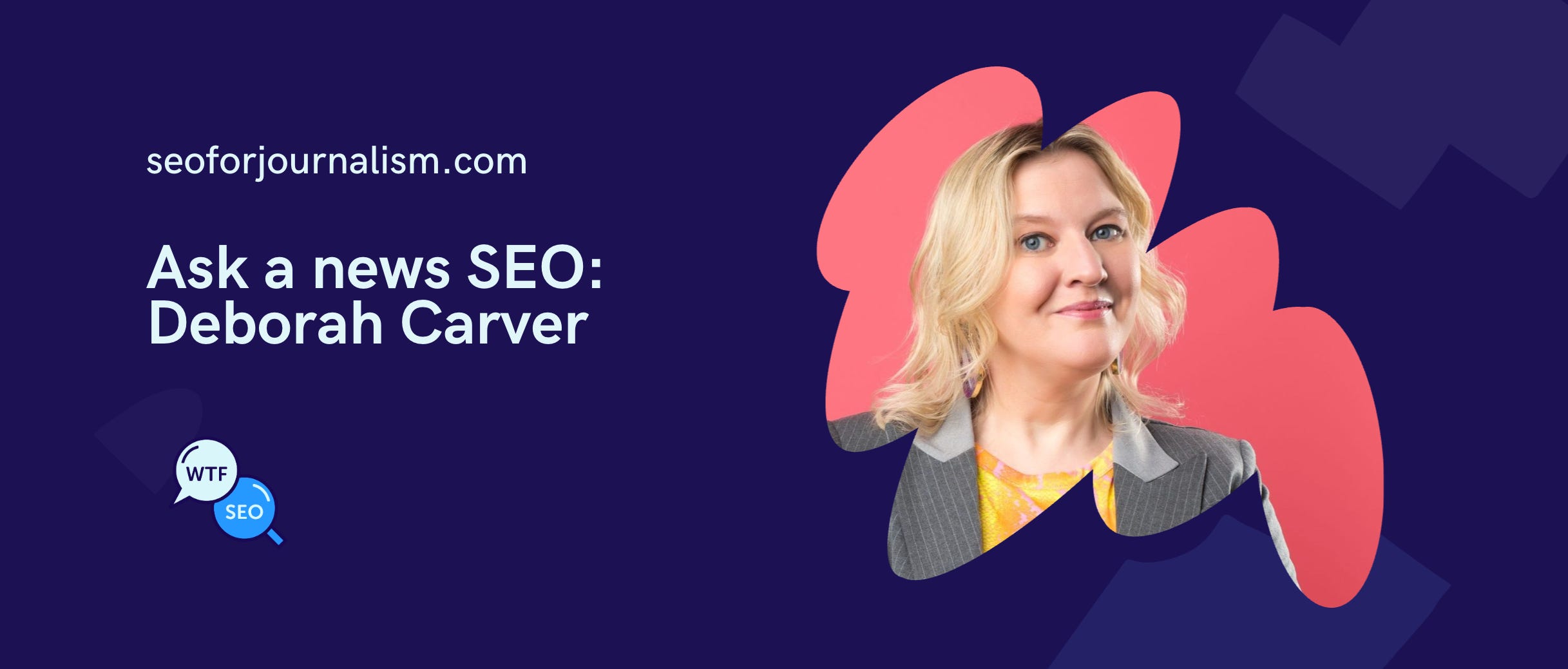
This week: Ask a News SEO with Deborah Carver! We talked about all the ways search is in flux, getting into the weeds of the pillars of brand building for publishers and the importance of social deep mining. Plus: why publishers need to focus on being more human.
Let’s get it.
THE INTERVIEW
WTF is SEO?: What are your thoughts on the state of search for publishers right now?
Deborah Carver: It is absolutely in flux, which is not something I would have said five years ago. I chose SEO over paid media in my career just because it’s slow. It doesn’t change quite as often — SEO changes over a course of about five years.
If you look at the history of what Google’s been doing, it’s not that it all follows in a trajectory, but the past three years have obviously been huge with chatbots coming onto the scene.
In the past year, at least personally, my search behaviour changed from Google-only to Google and Claude — as far as where I find information, like if I’m doing research for a client or writing a newsletter. I will often go to Claude to find some sources that Google’s not going to show me.
That’s the biggest advantage of chatbots: you can instruct them to ignore marketing websites and only show publisher websites.
There’s definitely this new added behaviour on top of all the other news behaviours that we have built over the past 20 years. But, none of the old behaviours are really going out of style. It’s just one more thing people are doing. This will change more, but it’s people who are information-seeking — like the typical news consumer — and curious. They’re going to more sources: a news feed, social feed, [Google] Discover or a chatbot. It’s not just going through the blue links [on Google].
As a publisher, having a clear brand will continue to be extremely important. The brand of the publisher itself seems to matter more than the general idea of journalism or publishing when people are trying to find trusted sources.
WTF is SEO?: Brand is something that we’ve talked a lot about. If you’re a publisher who wants to become a known brand on search and in the AI ecosystem, what are the pillars to invest in?
Deborah Carver: Having a consistent brand message that can last for years. Investing in that message and researching what will resonate with your audience. Having that message in all of the channels where you distribute content.
If I’m on Instagram and I see a Minnesota Public Radio post, I know it’s MPR because of the way it looks. That’s the physical branding. Then, the words that we use to describe our brands on About pages and [social] profiles. If a consumer is trying to find stable information, it is the same no matter what channel you’re looking on. You can adapt it for word counts and for social behaviour, but it’s mostly the same consistent message across the board. That’s number one.
Publishers want to jump on the newest thing. They want to be present in AI (although, I don’t know how many publishers are actually saying that); but they want to be present on this new channel. But then you forget that people still use your website every day. I don’t think there’s a day I haven’t gone to The New York Times since I was 25. I’m going to be in the nursing home like, “let me see the website.”
There are always going to be new ways of consuming information. But people — especially with news — like their habits. It’s about making sure that we’re not jumping on new things that alienate our existing audience, because that audience is the best representative of our brand.
The best kind of referral is word of mouth. Links are great, but it really is the audience perception of your brand. What do they do and who do you not want to lose?
One of the things that happened with The Washington Post is they changed their brand entirely and alienated their existing audience base that they’d just spent a lot of money gathering.
Be consistent and empathetic to the fact that your audience of news consumers are often really busy people trying to find information. Make sure you’re not losing that audience with new channels. Show your audience what’s most important and make sure that’s coming through on all channels.
News brands need to be very attentive to the fact that there is so much information. We’re all trapped in our algorithmic feeds and it’s up to news publishers to counter that.
I think publishers being a stable source of truth and a stable brand — that’s the long play.
That comes from consistency, listening to what your audience needs and structuring your content so your audience can understand that you’re acting in their best interest and not in the algorithm’s best interest.
WTF is SEO?: How does listening to your readers fit into the bigger audience strategy?
Deborah Carver: I do a lot of social listening and UX [user experience] research for brands. For audience research and social listening, you want it to be triangulated in some way.
Having focus group interviews with audience members and stakeholders once a year to ensure audience perception aligns with stakeholder goals is really critical.
I still do a lot of search listening and mining for my clients. I deep-dive into Google Ads data to see how search terms are changing around broader trends. I look at how people are finding a website via Google Search Console and identify other iterations of those keywords to understand not only how people find the site, but how they are interacting with news.
I’m a big fan of Google Trends for up-to-the-minute info and to monitor the conversation to see what has changed in an anonymous, aggregated way.
While eavesdropping on social media is great, having that anonymous data from Google provides more grounding. Social media conversation is very of the moment, whereas keyword data reveals the things people wouldn’t necessarily say in public. You search for things you don’t post on social media because you’re trying to figure out what is going on.
I’ve worked with the Google Ads API for a long time, and I find it often provides better, more grounded data than some of the standard trend tools.
WTF is SEO?: What are examples of things publishers are doing well right now?
Deborah Carver: I’m going to use Minnesota examples because news here has been extremely important to our daily survival.
Local publishers have done well ensuring their headlines align first with the facts, and then with the trends. It’s about making sure the “truthiness” stands out. If you are a news consumer looking for unbiased, classic journalism reporting, you can find it. It aligns with the natural way people search: “I need to find these facts because they’re affecting me right now.”
The stability of truth remains when there’s a lot of other noise and information out there. Our communities in Minnesota are linking to each other; that’s worked for finding information. News sites like Sahan Journal, Minnesota Reformer and Racket are collecting each other’s good information and shouting out each other’s stories. They’re working together to create an information environment. It’s a huge differentiator and a way to surface information that is not dependent on an algorithmic feed.
The biggest opportunities right now are understanding who your audience is and how they want to find your information.
That may not align with everything we’re hearing as far as AI trends. But, you need to have a good assessment of your data and the data that your company owns — not what everybody else is saying.
Finally, having a good user experience. Make your site more reliable than Google AI Overviews. Make it a stable source of truth. Look at your website’s search experience, too. Are people finding the information that they need? Can you make it better? Are they searching for things that they’re not finding?
It is a relatively small percentage of users [using the internal search function], but it can diagnose some pretty large problems.
WTF is SEO?: What do you think is the biggest challenge going forward for publishers?
Deborah Carver: Balancing understanding who your audience is and who your audience could be.
Not just digital signals, but also mixing those with human signals. Maintain that brand along with a very authentic social network, where competing news publications within the ecosystem also support one another. It is a social network of sorts where the community works together to support good information.
News publishers are finding the ways to create those networks. That’s a bigger opportunity than trying to show up in AI search all the time. We’re in an era where there’s so much technology. It’s time to be more human. Finding community is what keeps you rooted and that’s what keeps readers coming back.
#SPONSORED - The Classifieds

Get your company in front of almost 14,000 writers, editors and digital marketers working in news and publishing. Sponsor the WTF is SEO? newsletter!
THE JOBS LIST
Audience or SEO jobs in journalism. Want to include a position for promotion? Email us.
NBCUniversal is hiring a Senior Manager, SEO & AI Search Strategy (New York, N.Y.)
RECOMMENDED READING
Google news and updates
🤖 Matt Southern: Google clarifies how it picks thumbnails for Search and Discover.
🤖 Roger Montti: Google is updating AI recipe results to send more traffic to recipe blogs.
🤖 Matt Southern: Google clarifies how it chooses thumbnails for Google Search and Discover.
🤖 Barry Schwartz: New documentation says frequent crawling by Google is a good thing.
🤖 Danny Goodwin: Google’s Liz Reid says Search and Gemini may converge — or diverge — further. (???)
Even more recommended reading
🤥 Barry Adams: Google Zero is a lie. Here’s why
🔀 Glenn Gabe: Is AEO/GEO different than SEO? Information from the AI search platforms about AI search visibility.
📰 Sophie Culpepper: Is The New York Times a games company? A familiar debate continues.
🪭 Tom Wells: 83% of ChatGPT’s sources in carousel products are from Google Shopping via shopping query fan-outs.
💻 Dawn Anderson: Debunking and demystifying generative information retrieval: Misinformation in the SEO space.
🧪 Despina Gavoyannis: How to focus on topics (NOT keywords) in your SEO strategy.
🔍 Rand Fishkin: New research shows search does happen everywhere in an analysis of 41 sites with significant search activity.
What did you think of this week’s newsletter?
(Click to leave feedback.)
Catch up: Last week’s newsletter


Have something you’d like us to discuss? Send us a note on Twitter (Jessie or Shelby) or to our email: seoforjournalism@gmail.com.
Written by Jessie Willms and Shelby Blackley