


Hello, and welcome back. Jessie and Shelby here, back from a torrential downpour weekend. It did not stop raining once in Toronto, but despite the miserable conditions outside, Jessie took advantage of Doors Open Toronto to see the inside of the water treatment plant (legitimately cool) and the MOCCA. Meanwhile, Shelby hit a personal record of deadlifting 200lbs (or 91kg for our European friends, which makes the accomplishment seem much less exciting). The hamstrings are shot, but the pride is wide.
This week: What to know about what happened at Google I/O! Google’s annual conference featured a slew of new launches and information. And to cap it off, the company launched its May 2026 core algorithm update late into the week. We break it all down for you.
❤️🔥 Community call recap: Thank you to everyone who joined our spring community call, in partnership with Trisolute News Dashboard! The recording and transcript are now available. We’ll have the promised recap featuring podcast SEO insights from Steven Wilson-Beales soon (Google doesn’t respect our editorial calendar!).
Let’s get it.
THE RECAP
Four things to know from Google I/O
Google I/O, the search giant’s annual conference where they showcase news features and product updates, happened last week with no shortage of information.
The TL;DR for this year: AI is everywhere on Google — whether you like it or not.
Here are the biggest highlights and what publishers should know:
1. Google’s search box is getting a major upgrade
What happened: Google announced the first major changes to its search bar since 2001, making the main search box more dynamic and interactive.
Calling it the Intelligent Search box, Google’s revamped search box enables users to ask longer, more detailed questions — and upload various types of content (files, videos or photos and even Chrome tabs) as part of the query.
The Intelligent Search box is powered by Gemini 3.5 Flash and has begun rolling out in the countries and languages where AI Mode is available.
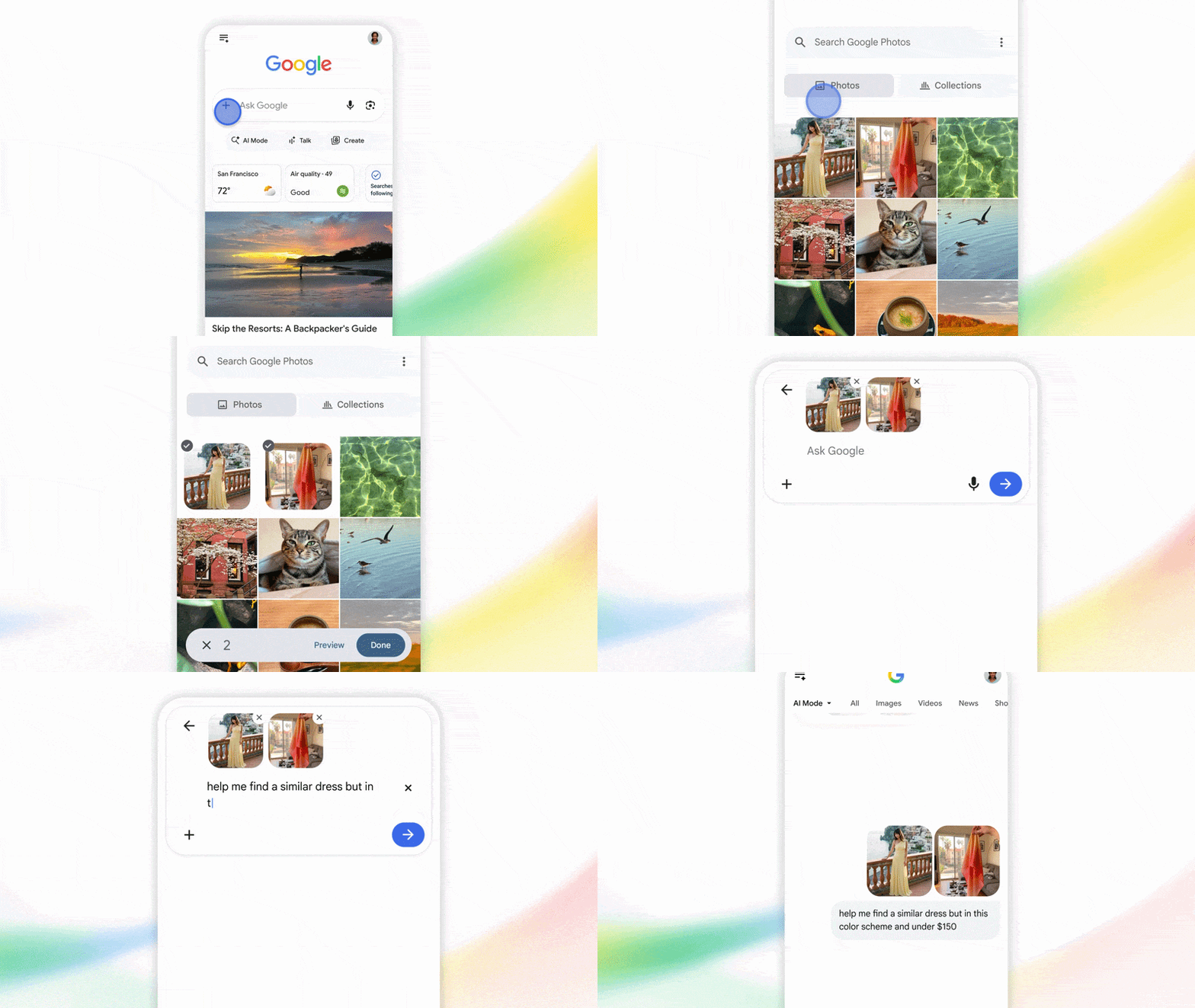
Why it matters: Google says this is the biggest change to the search box in nearly 25 years. It’s another reminder of how much Google has integrated AI into every part of search. The result is likely a further change in how users engage with content on the web. This means possibly an even more limited sandbox for publishers to find audiences. It’s likely more AI-generated responses, and with the increased visibility of AI Mode, could further reduce the need for users to click through to a publisher’s site.
2. Information Agents will help users stay updated
What is it: Google also announced new search AI agents. Operating in the background 24/7, Google says these agents will scan information across blogs, news sites, social posts, as well as Google’s real-time information — including finance, shopping, sports and more — to monitor for changes related to a user’s question. The agents will then send back “an intelligent, synthesized update, with the ability to take action.”
Google also expanded its agentic booking experience. Soon, Google Search will be able to find and directly book specific places or services. The company says restaurants, home, repair, beauty and pet care will roll out this summer in the U.S.
![information-agents-search.mp4 [video-to-gif output image]](https://substackcdn.com/image/fetch/$s_!HHS2!,f_auto,q_auto:good,fl_progressive:steep/https%3A%2F%2Fsubstack-post-media.s3.amazonaws.com%2Fpublic%2Fimages%2Ffcb879aa-e1cc-42bf-9c44-0039665cd57e_800x450.gif "information-agents-search.mp4 [video-to-gif output image]")
Why it matters: Google is implementing (and improving) systems that will work for you in their ecosystem even when you’re not directly on Search. The agentic systems could make tasks like apartment hunting, deal shopping or even monitoring a major news moment (like a sports trade or an election) easier for users.
3. Agentic coding will power new apps in Search
What is it: Google is enabling users to build their own “mini apps for your own specific tasks” directly in Search. Google Antigravity and the agentic coding capabilities of Gemini 3.5 Flash — which was also launched at Google I/O — will power these apps. This includes custom graphics, visual tools, trackers, simulations and other custom layouts in real time, in the format and with sources the user prefers.
“Search can build the ideal response, in the right format for your question — completely on the fly. So you can get custom generative Ul, including visual tools and simulations, tailored precisely to your needs,” Liz Reid, the head of Google Search, said.
This feature will roll out globally this summer.
Why it matters: Google Search is no longer just a library. The ability to create in Google Search transforms the purpose and intent of the user journey. Additionally, the ability for users to create custom graphics could become a major blow to publishers that have heavily invested in tools like financial watchlists or interactives. Google Search will give you the answers you want, but also transform that information into a preferred format, all within the Google ecosystem.
4. Personal Intelligence goes global
What it is: Google expanded its personal intelligence capability to more users in nearly 200 countries with no subscription required. Previously, it was only available in select markets with a fee. This will enable users to fully connect Gmail, Google Photos and soon Google Calendar to sync with searches in AI Mode.
Why it matters: This is not surprising. After launching this in a few markets in January 2026, it was only a matter of time before a global rollout. It was clear Google was moving in this personalized direction with the launch of Preferred Sources, and this furthers that theory. The integration of Gmail, Google Photos and Google Calendar makes Search a much more personalized experience. Readers who subscribe to or engage with a specific publisher’s content may see more of those topics — and therefore news outlets — ranking on SERPs or being cited in AI responses.
THE REAX
Reactions and responses to I/O
Aleyda Solis for SEOFOMO: “The default toggle didn’t flip to AI Mode, but the entry point into Search is becoming a much stronger bridge between traditional Search, AI Overviews, AI Mode, multimodal inputs, personalization and agentic actions.”
Katie Notopoulos for Business Insider: “But a version of the new AI search is one where you never have to venture out onto the internet; it’s brought to you in a sanitized form by an intermediary. It’s like living in a gated community with a strict HOA vs. a walkable city with public transit … I don’t want Google search to trap me into its AI HOA! I want my internet experience to have a tacky-colored house, an unkempt lawn, and a year-round 12-foot Home Depot skeleton. That’s what the internet should feel like to me: something to explore and venture out into, even if that means a tiny bit of imperfect friction.”
Jay Peters for The Verge: “Google isn’t just showing you the location of information anymore. Through its various search boxes, it’s now just answering questions for you in a way that it thinks is most helpful. In the most charitable view: If it’s done well and accurately, this all could be very useful. But that means it has to be done well and accurately, and that’s an extremely high bar to clear, especially with complex search queries or questions about sensitive data like my years of emails in Gmail.”
#SPONSORED - The Classifieds

Get your company in front of more than 14,000 writers, editors and digital marketers working in news and publishing. Sponsor the WTF is SEO? newsletter!
THE JOBS LIST
Audience or SEO jobs in journalism. Want to include a position for promotion? Email us.
The Daily Mail is hiring an Audience Editor (London, U.K.).
Newsweek is hiring several roles including news editors and a Head of Consumer Social (Remote, U.S. and U.K.).
EVEN MORE RECOMMENDED READING
🌪️ Matt G. Southern: Google launched a core update on May 21; it could take up to two weeks to complete. It’s the fourth update of 2026, following a previous March core update as well as spam and Discover updates.
🛍️ Barry Schwartz: In addition to the agentic features mentioned above, Google also announced some commerce features, including the Universal Cart.
🤦 Lily Ray: “Oh man, Google seems to have rolled out AI Overviews for new types of queries this week, including many words that previously generated dictionary results.”
🔬 Rasmus Kleis Nielsen: Generative AI news discovery looks much more concentrated than other forms of access.
🤔 Gianluca Fiorelli: The Schema question, reframed or trying to clarify what it is for.
What did you think of this week’s newsletter?
(Click to leave feedback.)
Catch up: Last week’s newsletter


Have something you’d like us to discuss? Send us a note on Twitter (Jessie or Shelby) or to our email: seoforjournalism@gmail.com.
Written by Jessie Willms and Shelby Blackley