


Hello, and welcome back. Jessie and Shelby here, back from a (concerningly) stunning fall weekend that somehow kicks off November? How are we into the final two months of the year already? Jessie spent the weekend in a mad dash to finish a hexagon crochet sweater. Meanwhile, Shelby distracted herself from the horror show known as the Ravens game by finally finishing her Legend of Zelda LEGO build, just in time for the new video game to come out Thursday. Nerds, let us rejoice!
This week: Google news and updates! Remember when things were chill? Us neither. We recap the most recent updates with the biggest search engine and what you need to know.
📅 Mark your calendars: We’ve partnered up with Trisolute News Dashboard and special guest Louisa Frahm to bring you a workshop on how publishers should approach non-commodity content in the AI era. Ask a question.
Let’s get it.
THE 101
Google algorithm update almost certain within the month: analysis
What happened: An analysis conducted by SEO strategist Dan Taylor for Search Engine Journal estimates a 96.8 per cent likelihood of Google rolling out a major core algorithm within the month. Based on a model trained on 25 years of Google update patterns and real-time SERP analysis, the model also reported a 91 per cent chance of an update in the next 90 days.
The analysis draws comparisons to Google’s notorious Panda update from 2011, a major change to Search that deprioritized low-quality and spam content. Over the past few months, Google has been updating a significant portion of its documentation, specifically targeting scaled AI or low-quality content, misinformation and fake authors.
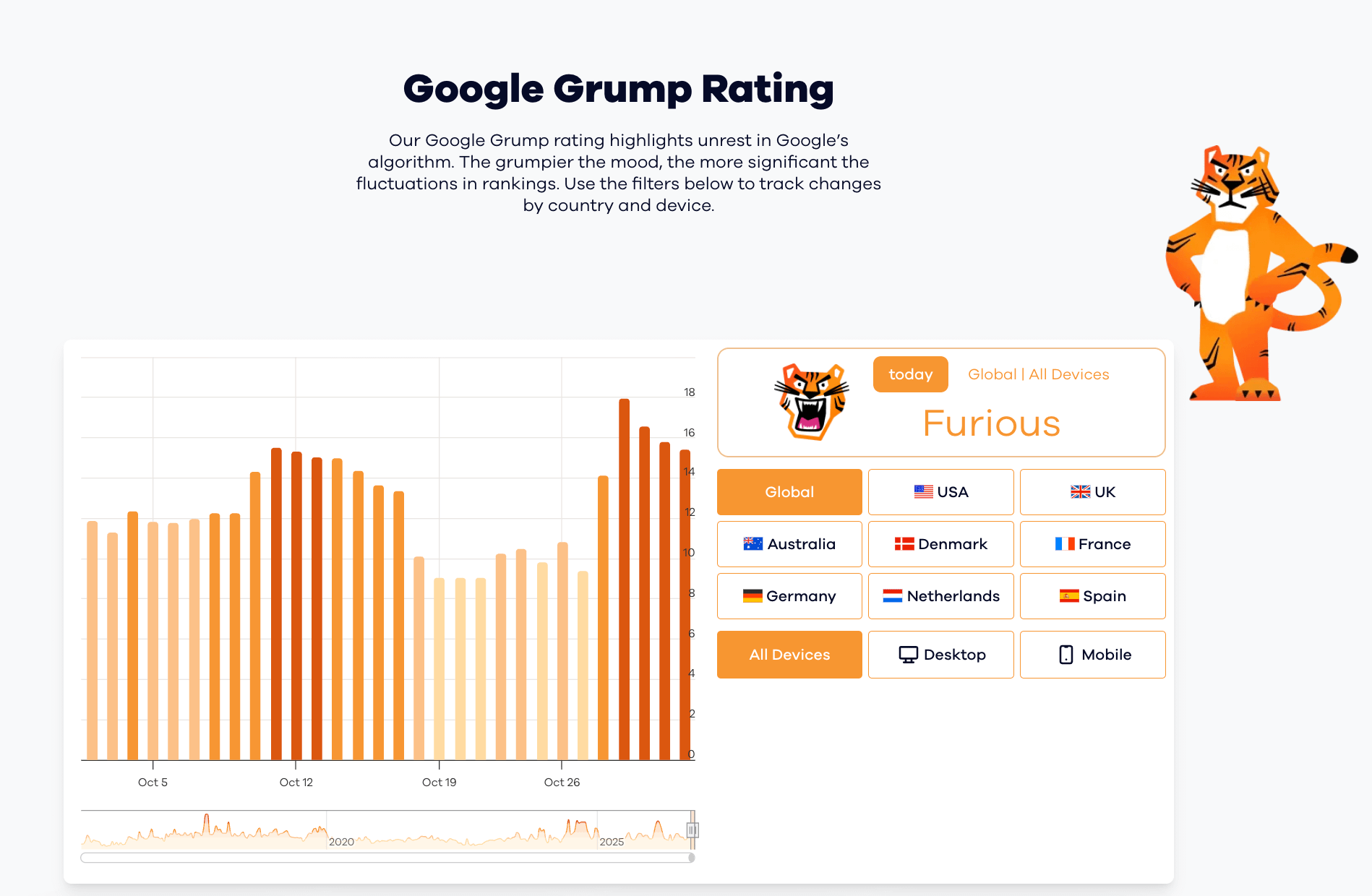
Why it matters: Google is significantly overdue for an update, and the SERPs have been anything but calm. Google has not announced a major update since May 2026, but there have been several spam updates. It’s possible Google has made smaller unannounced updates throughout the year — something Glenn Gabe says is quite common. It’s only a matter of time before Google unveils an official core update.
AI Overviews are now more common than traditional News Boxes
What happened: A study published by Search Engine Land found that AI Overviews are pushing traditional News Boxes out of search results, appearing more frequently than Top Stories.
According to Comscore data, AIOs appeared in 39 per cent of all U.S. desktop searches in June 2026. Since summer 2026, AI Overviews were updated to include Top Stories boxes within the summary.
There is also a clear shift from News Box-only search results to those that combine Top Stories and AIO results. The study, based on an analysis of data from October 2025 to August 2026, found that 75 per cent of results had only a News Box in October, but that figure fell to 34 per cent in August. In that same period, the share of AIO-only results rose from 5 to 33 per cent. (For this analysis, “News Box” refers to both Top Stories and features like Also in The News.)
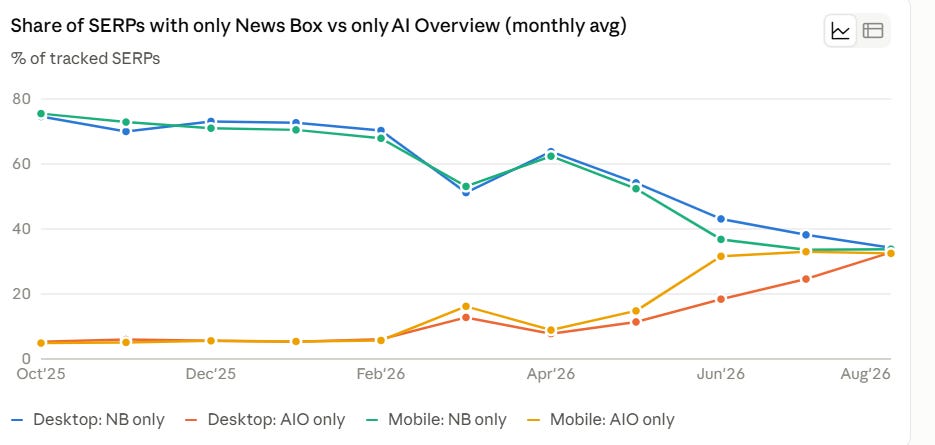
The analysis found that Google is largely displaying an AI Overview with Top Stories embedded within the response, or the Top Stories box alone — not both.
Why it matters: Top Stories are a foundational part of search traffic for publishers. With Google expanding AI Overviews further into news searches — including the once-protected hard news queries — publishers will continue to feel the squeeze.
Last month, Google announced it was increasing “the presence of inline links“ in AI Overviews and AI Mode. More inline links within AI experiences create more ranking opportunities, even if they are less prominent than traditional News Boxes.
The report concludes that sites that are having their content summarized need to determine “how often the publisher is cited in AI Overview responses for those key coverage areas.” Then, review the impact on CTR; if traffic from these areas has fallen dramatically, ask “how can this content do something AI can’t?”
Google value plunges, suffers worst decline ever
What happened: Google suffered its worst day on record last Thursday as shares declined nearly 13 per cent, almost USD $500-billion of parent company Alphabet’s market value. Alphabet reported lower-than-expected profits, and revealed that the AI incorporations to Search are impacting its advertising business. However, the company insists it will continue to heavily invest in AI, saying they feel “very good about our trajectory.”
Why it matters: Despite reporting that total revenue grew 25 per cent in between July and September, Alphabet did not make as much money as predicted, especially from its advertising arm. This was an early concern of AI chatbots, including AI Mode, which is “eating into the money [Google] makes from ads which appear next to results to traditional search questions,” as the BBC reports. However, Google seems to be going all-in, and considers the long-term investment in AI worth the short-term hit.
Reuters reports AI is no longer an experiment, but a part of our lives
What happened: The Reuters Institute for the Study of Journalism published a report on how different countries use and interact with generative AI in their everyday lives, and what they think the impact will be, including on news. The study found that weekly use of AI systems grew from 34 per cent in 2025 to 51 per cent in 2026. Interestingly, 57 per cent of respondents said they encounter AI-driven features in search engines, and 21 per cent see it across social media and messaging apps (outside of traditional AI chatbots). The survey also found that there is remaining public skepticism about how AI applications are embedded, especially in places like newsrooms. People are generally uncomfortable with AI-made content. One in ten people say they are paying for access to AI systems.
Why it matters: This study signifies that generative AI is no longer an experimental novelty, but a primary component of our lives and how audiences find information. As AI continues to be integrated into the myriad of platforms and applications readers use, publishers must focus on value over scale and direct relationships, while remaining true to their missions.
#SPONSORED - The Classifieds

Get your company in front of more than 14,000 writers, editors and digital marketers working in news and publishing. Sponsor the WTF is SEO? newsletter!
THE JOBS LIST
Audience or SEO jobs in journalism. Want to include a position for promotion? Email us.
NBC Sports is hiring a Freelance Editorial Distribution Specialist (remote).
EVEN MORE RECOMMENDED READING
📉 Charlotte Tobitt: AI content retrieval “already eating away” at publisher businesses, court told.
👇 Scharon Harding: Reddit’s search referral traffic “was down meaningfully” in the last quarter, the company reported.
⌨️ Andrew Deck and Hanaa’ Tameez: Legal experts warn Meta’s new terms still grant broad scraping permissions, despite language changes.
📹 Rick Tousseyn: Adding video to written content can boost its AI citations, according to a OtterlyAI study.
🤖 OpenAI: Browse data to see how ChatGPT is used at work and for personal reasons around the world.
What did you think of this week’s newsletter?
(Click to leave feedback.)
Catch up: Last week’s newsletter
Join our AI Search webinar [together with Trisolute]

We are thrilled to invite you to a special panel discussion hosted in partnership with Trisolute News Dashboard on November 18, 2026.


Have something you’d like us to discuss? Send us a note on LinkedIn (Jessie or Shelby) or email us (WTF is SEO? Newsletter).
Written by Jessie Willms and Shelby Blackley