


Hello, and welcome back. Jessie and Shelby here, back from the first (semi) official softball weekend! Get ready, dear reader: not only is Jessie playing in another four(!) leagues, but Shelby is subbing for two of them! Stay tuned for stories about Jessie getting hit in the face with a ball, or Shelby missing the perfect pitch. Or both, really. It’s softball season!
This week: How to do multimodal search! Last week we went through the 101. In this issue, we break down how to start approaching a multimodal strategy in your newsroom.
🚨 Happening soon! Our spring community call is Wednesday, May 20 at 11 a.m. ET/4 p.m. GMT! In partnership with Trisolute News Dashboard, Steven Wilson-Beales will join us to discuss all things podcast SEO! Register to receive a reminder and ask a question.
Let’s get it.
THE 101
What a multimodal content strategy should look like
A multimodal future requires changing your current editorial content strategy and incorporating distribution channels earlier in the process. It requires taking one piece of content and making it work on multiple platforms.
The content itself must be multimodal: it needs to engage in different ways that make sense for a specific platform (whether it be video, text or audio). It might also be optimized for multimodal search (the various ways the content can be found).
For example, a 90-minute video podcast can be posted on YouTube as well as Spotify, but then sliced into short-form vertical videos to catch the attention of users on TikTok, Instagram and YouTube Shorts. Quote highlights can be posted as static graphic cards on Instagram.
Each of these pieces of content should be fully optimized — with the right keywords, tone, etc. — for that surface.
And then on-site, key snippets can be embedded in relevant news articles. The podcast can also run on-site with its own article page and the full text transcript. It can also be summarized in newsletters or other text-based content.
Example: The Guardian’s Today in Focus podcast is shared as audio on Spotify and Apple, appears as a full video on YouTube and is hosted on-site in an article page (with the video podcast pulled into relevant stories). Key moments are also clipped into standalone short videos on TikTok, or carousels on Instagram.
This is just one example of taking a piece of content — in this case, a podcast — and ensuring it’s visible wherever your audience is. This expands the entry points to connect with people on their preferred platforms. It makes you more visible across the entire Google ecosystem, protecting your authority and increasing brand awareness.
THE HOW TO
How to start thinking about multimodal as an audience editor
Over the last several years, Google’s ecosystem has changed. The old landscape that publishers played — and succeeded — in doesn’t exist anymore. That means audience editors need to change how we think about Google and audience as a whole.
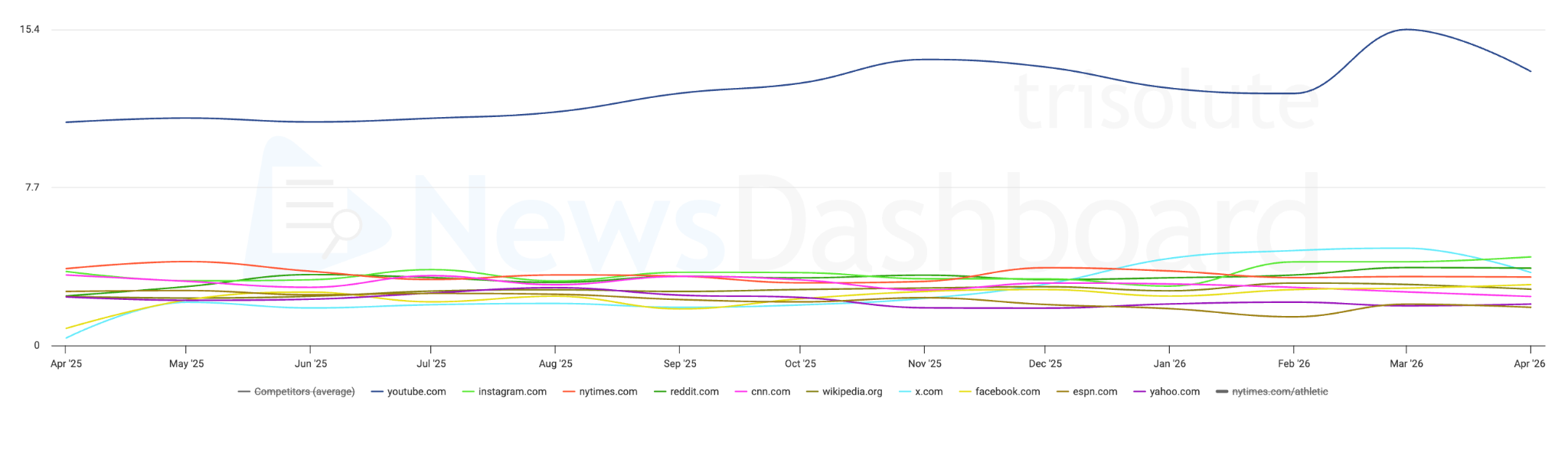
Below is a look at the visibility of websites for the general keyword set on mobile from Trisolute News Dashboard. Taking into consideration all features on Google (top stories, organic, visual digest, etc.), YouTube (which is owned by Google) is far and away the most visible site. Second (by a wide margin) is Reddit (which partners with Google). After The New York Times, CNN and ESPN, the other top “publications” are all also distribution platforms.
When taking YouTube’s monopoly out of the equation, an even more interesting narrative emerges. Notably, Facebook and Twitter/X were almost non-existent in Google’s ecosystem in April 2025. A year later, Facebook has risen from 0.8 per cent to 2.97 per cent visibility, while Twitter/X has catapulted from 0.37 per cent to 3.56 per cent visibility in April 2026. It is currently the fourth-most visible site, behind YouTube, Instagram and Reddit.
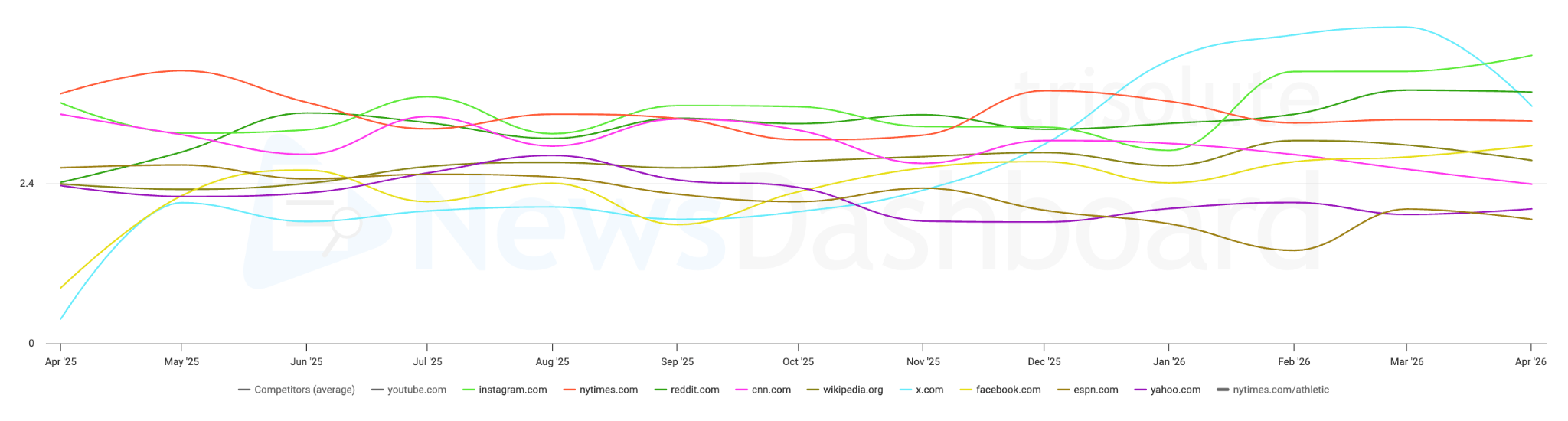
This fluctuation in visibility confirms a trend we already know: the audience is not monolithic. People are finding news — even still with Google as the main entry point — in a myriad of places and in a myriad of ways. As such, we must stop treating content like it’s a monolithic entity.
This means we must move beyond text. For a long time, we focused exclusively on text-first optimization — keyword research, SEO-driven headlines and backlinks. Now, Google — and more importantly, the readers — are considering other forms of content. We need to keep up.
First step: Take inventory of where you are
The first step for multimodal search is understanding what you currently publish and where that content lives. This audience will reveal a load of opportunities, but limitations, too.
Take inventory of where you currently post content and engage with audiences:
What podcast shows go on Spotify, Apple AND YouTube?
Are podcasts hosted online on-site? Is the transcript readily available?
Does your outlet post on TikTok? How many posts per day or week? Are podcasts posted here?
What about Instagram Stories and Reels?
Are you posting on Facebook or Twitter/X? How often and what content?
Then, take inventory of what does well:
Which posts/content types perform above average against the platform’s native data?
What do people talk about on Reddit about your brand?
What social posts tend to “go viral”?
Which podcasts have the top downloads?
Which journalists are most well-mentioned?
Answer all of the above in a Google Doc or Spreadsheet to determine the current strategy.
Work with stakeholders to identify the gaps
People in your newsroom are likely already working on video or podcasts, but are probably siloed from the larger newsroom. Be the bridge between these teams.
As an audience editor, you should have an eye on the data. What stories are doing well on-site? Translate your on-site successes to off-site opportunities. If a story is doing well on-site, it comes automatically with more internal buy-in. This usually means more resources. Capitalize on this and expand the story’s reach off-site.
For example: You learn a major investigation did really well on-site yesterday. Can the reporter translate some of that work by annotating the case on video, which can be distributed on Twitter/X, YouTube Shorts and TikTok? Should they go on your morning daily podcast? What about a Reddit AMA in topically-relevant forums? And on-site Q&A with subscribers? Can you run a “behind the scenes” interview with the writer for your flagship newsletter and record the video for another platform?
Think of the internet distribution methods like a mind map. If you have a single piece of content, how many different ways can we repurpose this? Build out this strategy for major stories first, then branch out.
Work with people who know the platforms. Audio and video editors are elite humans. Describe your vision for off-platform visibility, and ask how you can collaborate to bring it to life. Be open to feedback and criticism: sometimes what may seem like it’s a light lift actually takes more resources than you think.
Test, test, test
A multimodal approach forces a testing and learning culture. Not everything is going to land for every platform, but the more you try and adjust, the more you’ll learn what each audience needs. It’s not always the same for each audience. That’s the point!
Use data that informs your efforts. The tricky part about this “new era” of audience research and development is that not all data is equal. On-site metrics inform a direct traffic-to-revenue relationship, but engagement on TikTok doesn’t quite return the same bottom-line number for a business.
However, those numbers can relate to brand awareness. Find a way to connect engagement on posting platforms to a metric, like Comscore, or an increase in unaided brand awareness.
Multimodal search is all about being optimized for any form of searching, whether that’s on Google or TikTok or ChatGPT. This is a fluid environment. Testing is how you find success.
THE EXPERTS
What the experts recommend
Steven Wilson-Beales: Multimodal breaks the idea that audiences are being served just by what comes out of your CMS — which is primarily text. Audiences (and LLMs) consume information in different formats across a variety of surfaces. We now need to consider:
What is the story? What is the essential seed of the story and what are the best formats that will allow that seed to bloom?
ONE team: Product, video, audio, data and writing teams all need to be aligned. Know what to prioritize through silky smooth team communication.
Redefine success: We used to measure a win with a click, and it didn’t matter who clicked. Now, if we are laser-focused on the right audience, there are other engagement signals we can celebrate.
The best future editors will also be audience engineers: those who can spot the story and can work with teams to amplify it both to humans and to the machines.
Louisa Frahm: In the multimodal search era, publishers should strive to diversify entry points and guide readers through an expanded digital editorial experience. A single trend can spark a traditional article, YouTube clip, TikTok explainer and/or Reddit post that could pop on SERPs. The goal is to meet your readers anywhere and everywhere that they consume content, with text and visual offerings in timely windows.
Publishers need to provide answers to search-friendly questions across content on different platforms. Balancing quick-hit stats alongside expert analysis can simultaneously appeal to AI modules and encourage readers to dig deeper into your coverage. To execute a successful multimodal search strategy, it will be imperative to consistently educate stakeholders on evolving industry trends and secure cross-departmental collaboration with top-down support.
Deborah Carver: Multimodal is like all channel optimization: figuring out which details agents use to access and evaluate information so your brand can look good wherever you may show up. Sometimes, that means filling in “backstory” in the schema markup. Google doesn’t use that field to evaluate, but emerging news authority algorithms might. AI tools can make this tedious process much easier, if you have an eagle-eyed and brand-aware copy editor reviewing everything before it goes out.
#SPONSORED - The Classifieds

Get your company in front of more than 14,000 writers, editors and digital marketers working in news and publishing. Sponsor the WTF is SEO? newsletter!
RECOMMENDED READING
Google news and updates
🤖 Google: Best practices for ‘Read more’ links.
🤖 Barry Schwartz: Google adds Read more links best practices.
🤖 Roger Montti: Google won’t act on spam reports if they contain personal information.
🤖 Jean- Christophe Chouinard: Slides and takeaways from Google’s Toronto Search Central event.
🤖 Roger Montti : Google added new tasked-based search features.
Even more recommended reading
👑 Louisa Frahm: Utility news content: How to win beyond clicks in AI search.
🔗 Matt G. Southern: Click-through rates for brand-cited AI Overviews fell as impressions grew faster than clicks across cited pages.
🤔 Matt G. Southern: Google’s Head of Search Liz Reid said AI Overviews cut “bounce clicks,” not deeper visits.
🤔 Gianluca Fiorelli: “Search as Agent Manager”: What Pichai’s interview really means for SEO, commerce, and the open web.
📃 Louise Linehan: Why ChatGPT cites one page over another, according to a study of 1.4 million prompts.
💰Hayden Field: You’re about to feel the AI money squeeze.
🖱️ Tracy McDonald, Hannah Cooley and Marketa Williams: AIO impact on Google CTR: A 2026 update.
🧩 Davis McCain: How query language reshapes AI citations.
🐑 Cyrus Shepard: 17 content types to survive Google’s zero-click future.
What did you think of this week’s newsletter?
(Click to leave feedback.)
Catch up: Last week’s newsletter


Have something you’d like us to discuss? Send us a note on Twitter (Jessie or Shelby) or to our email: seoforjournalism@gmail.com.
Written by Jessie Willms and Shelby Blackley