


Hello, and welcome back. Jessie and Shelby here, back from a devastatingly smoky (and then beautiful) summer weekend and the final days of the 2026 World Cup. It came, it caused chaos and it left… but not before driving Shelby mad. The good news: only four months ‘til U.S. elections midterms! 🫠
This week: Ask a News SEO with Nicola Agius, SEO and Discover Director at Reach PLC. We discuss the current state of Google Search, the concerns of AI and where opportunities lie for publishers.
Together with Marfeel: Missed our AI in Search webinar? Catch up with the recording now!
Let’s get it.
THE INTERVIEW
WTF is SEO?: Search and Discover have changed a lot. Can you talk about the biggest changes you’ve seen, specifically in the U.K., and how you think it’s affecting publishers?
Nicola Agius: AI features are just everywhere — we really saw this during the World Cup that’s just finished. Live blogs during the World Cup were obviously a huge opportunity for search traffic. But when you’d search any match or team, Google would serve so much AI at the top of the SERP; diagrams, more information about the sport, player lineups, who scored, the number of minutes we were into a match, player stats and so on. That was challenging for publishers.
Historically, typical live blog headline formats like, “England vs America live: Score, latest updates, etc.” would draw huge numbers — but that kind of headline doesn’t work anymore because all that information is provided by Google’s AI right at the top of the SERP.
However, what’s interesting is that despite all of all of this, people are still scrolling down past Google’s AI content and browsing the Top Stories carousel. We know this because we’re still getting those impressions. Click-through rate (CTR) isn’t as high, but people are still scrolling down — which is an opportunity for publishers. Although people have the facts provided by AI, they still want more information — and we need to figure out what that is.
In response, a lot of the training we’re giving at the minute is around CTR, keeping in mind how AI has changed the game. I’m telling our reporters, “don’t think of yourself as a journalist, think of yourself as a sports fan. What questions do you have after reading all of those facts provided by AI?” Lean into analysis, your expert opinion — you’re the football experts, right? Lean into that. Lean into reactions, the discussions happening online. That’s one challenge we’re facing right now and that’s how we’re trying to overcome it.
Another challenge we have, which may be trickier to solve, is Google appears to be testing its own version of live blogs that are served above the Top Stories carousel in the SERPs. I saw one for EuroVision; it included key events with live reactions from Twitter (X). It’ll be interesting to see how that develops. I’ve seen it a couple of times, but haven’t seen any official announcement from Google.
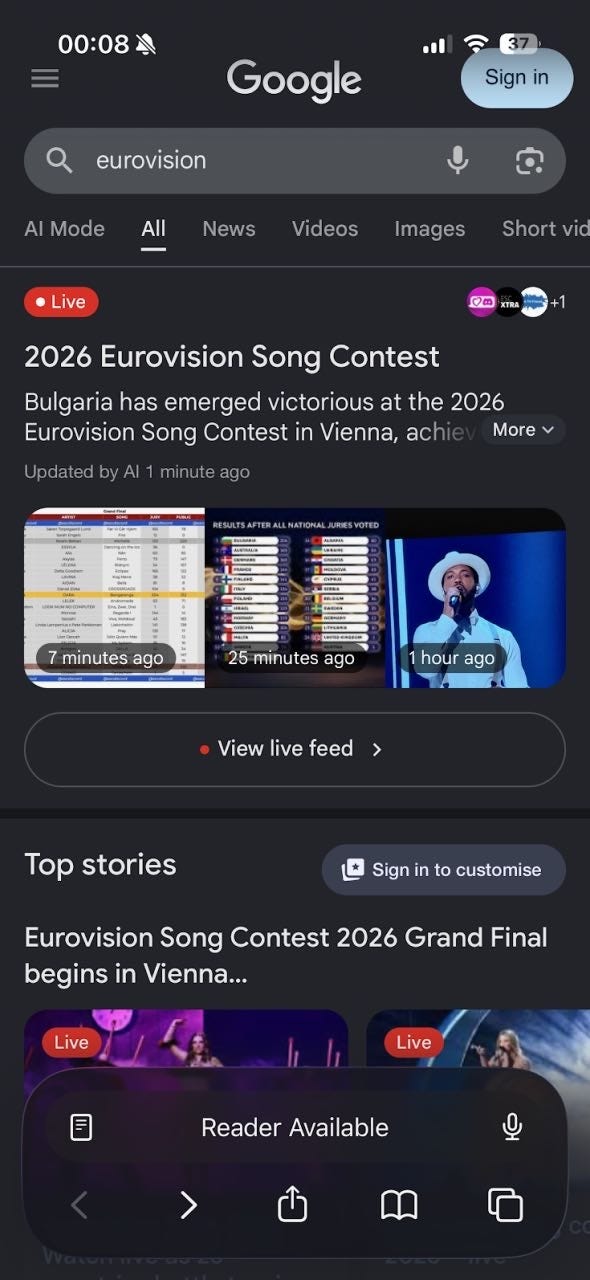
This is pretty concerning because live blogs are still one of our biggest opportunities when it comes to search traffic and if Google’s going to tap into that — which I don’t understand how or why that benefits Google or searchers — it could be a problem.

WTF is SEO?: Those seem like two separate things; what benefits Google and what benefits the user. What does Google get or think it gets by providing its own live blog?
Nicola Agius: Exactly. It’s about keeping people within the ecosystem. But how are Google improving their product with something that doesn’t really serve user intent? Is an AI-generated blog really what searchers are looking for during a football game? Surely they want to hear from football experts and be part of the conversation? I suppose then that’s where we as publishers really have to lean in. Rather than focusing on general reactions that Google’s AI can assemble together from social media, we need to make sure people care about the reactions from our expert reporters — which is something they can only get from our sites. It’s about making our product so good with such brilliant journalism that people actively seek our reporters’ opinions on that content, rather than an AI-generated blog from Google.
The SERP has changed so much over the last 12 months. I’m seeing a lot more “What people are saying” carousels, different content formats and I’ve also noticed, for the first time, that Facebook posts are getting visibility in the Top Stories carousel. In Aleyda Solis’ analysis of the May core update, she observed that Google now seems to better understand user intent regarding content type. When people are searching for a query, do they want to see a social post? Do they want an explainer? Do they want video? We as publishers need to think a lot more about content types and should be working closely with social teams. We need to think outside the box of standard news articles.
WTF is SEO?: Interesting. And what about Discover? Should publishers still focus on it?
Nicola Agius: We’ve seen a hell of a lot of changes on Discover over the past 12 months. It really started with the June core update last year. I work for Reach PLC, so I have oversight of like 60-70 news sites. With access to so many properties in Google Search Console, I can see what shifts are happening.
In the first half of last year, national sites absolutely killed it in Discover. Then, with the June [2025] core update — at least here in the U.K. — there was a massive switch in the algorithm where Google started giving a lot more visibility to smaller publishers, regionals and more niche publishers. While analyzing Google’s May 2026 core update, I noticed that the number of domains getting into Discover was up 64 per cent year-on-year in May.
The platform is so different now to what it was in January last year. It’s the same space we’re all competing in, but now there are a hell of a lot more publishers that we’re competing against. And there’s a lot more stories getting into the Discover feed, as well. Content in the Discover feed was up 58 per cent year-on-year, comparing May this year to May last year. On top of that, social — like X and YouTube — now accounts for almost a quarter of the Discover feed, which is crazy because this time last year, X wasn’t really in there at all. YouTube was, but just a bit.
On top of that, we now have AI Overviews in Discover. And we also have combined Discover cards, where as many as 100 publishers can be grouped together, according to Damian Andell’s research. It’s important to note that Google isn’t just grouping together the same story on combined Discover cards, it’s grouping together different angles and unique takes on headlines with the same entities, which does the user a disservice.
It also contradicts what Liz Reid [Google’s VP of Search] said on an AI podcast the other day. She said, “The more publishers produce content that is really where they shine, what they bring to the table, where it’s unique and not the 10,000th copy of the same story, but something that has an interesting take on it, the more I think we’ll see people continue to click through. And that’s something Google wants.” That’s what Liz had to say, so why is Google grouping articles with unique and interesting takes together?
I’m currently looking into how Google decides to group content together and I’m providing guidance to our newsrooms on how we can potentially minimize this risk.
WTF is SEO?: What are positive things you’re seeing in the space for publishers?
Nicola Agius: I do think that Preferred Sources and features like that are a step in the right direction. It gives you more visibility in Search and Discover and, according to Google, your CTR doubles if you’re a preferred source.
Another positive is audience diversification. There’s been so much discussion about Google zero or people ditching Google for ChatGPT or TikTok, when the reality is, people are using all of these platforms together. That’s a positive for publishers because it means that you don’t have to be so overly reliant on a single referrer because your audience is everywhere now.
Think about your audience and how they find content. Are they younger? Maybe they are on TikTok as well as Google. Remember, TikTok really is a search engine, too. So is YouTube. So, use your SEO skills there. Publishers should never put all their eggs in one basket. Did we learn nothing from the Facebook traffic collapse of 2018?

WTF is SEO?: What do you wish you had known about SEO when starting?
Nicola Agius: There’s no such thing as an SEO expert. That’s my opinion. When I started, I definitely had a lot of imposter syndrome. I never wanted to post on LinkedIn because I was afraid of saying the wrong thing. I’d attend webinars and conferences to hear the experts talk and I’d be like, wow, they know so much more than me. And then I worked for Search Engine Land with SEO legends Barry Schwartz and Danny Goodwin — I was like, God, I’m never going to know as much as Barry and Danny!
But the thing is: Google’s changing all the time. Some of what you thought you knew last year probably isn’t even relevant today for reasons beyond your control. In SEO, you have to keep learning. Everyone who I respect in the industry is constantly learning — nobody knows it all. That’s why I think there’s no such thing as an SEO expert. You can never take your foot off the pedal. And remember, the loudest person in the room isn’t necessarily the smartest person in the room.
#SPONSORED - The Classifieds

Get your company in front of more than 14,000 writers, editors and digital marketers working in news and publishing. Sponsor the WTF is SEO? newsletter!
THE JOBS LIST
Audience or SEO jobs in journalism. Want to include a position for promotion? Email us.
Immediate is hiring an Audience Development Manager (Hybrid, London, UK).
Wirecutter (NYT) is hiring an Audience Editor (New York, USA).
The Daily Mail is hiring a Senior Newsletter Editor (London, UK)
RECOMMENDED READING
Google news and updates
🤖 Google: How to read the Indexing Report.
Even more recommended reading:
🗞️ Barry Schwartz: Top Stories rolls out in Google’s AI Overviews.
🤔 Ihab Rizk: Introducing Topic Insights: Actionable content recommendations in Microsoft Clarity.
📉 Dan Taylor: Why scaled AI content fails: Google’s crawl economics explained.
👥 Nick LeRoy: The worst thing you can be in an SEO job interview is forgettable.
🧠 Gianluca Fiorelli: The Open Knowledge format: What Google really shipped, and why the interesting question is not SEO
🌲 Harry Clarkson-Bennett: “You can still have real impact with evergreen content — but not with the methods that worked five years ago.”
What did you think of this week’s newsletter?
(Click to leave feedback.)
Catch up: Last week’s newsletter


Have something you’d like us to discuss? Send us a note on LinkedIn (Jessie or Shelby) or email us (hello@seoforjournalism.com).
Written by Jessie Willms and Shelby Blackley