


Hello, and welcome back. Jessie back from a Weakerthans fantasy draft! If you’re a millennial indie rock head with an adoration for cats and emotionally devastating lyrics, this is the band for you. It doesn’t hurt that the lead singer — dubbed Canada’s greatest songwriter (by me) — is also a prolific crafter.
This week: SEO metrics that matter in 2026. A lot has changed in news SEO since we covered key metrics back in 2023. We discuss some of the new north stars publishers should consider in the AI era.
This is not a comprehensive view. The metrics that matter will — and should — vary between newsrooms. Each organization has different business and editorial goals and ultimately, metrics should evaluate success or failure against those unique objectives. Align KPIs accordingly.

Let’s get it.
THE 101
What metrics still matter for search
AI upended search results. Google revamped its core product. User behaviour has shifted. With that upheaval, some old metrics are less valuable, while KPIs that measure performance against business and editorial goals (like conversions and engagement) matter more.
We’ve highlighted four SEO metrics below that still matter and some you can downgrade.
It’s worth noting: AI metrics — and currently most metrics in SEO — are very hard to track accurately and consistently. Google doesn’t yet provide click data for its AI features, and other tools not foolproof. Always keep a skeptic eye when reviewing any data.
The metrics that still matter
Conversions (subscriptions, registrations, sign ups) from search
What it is: The number of readers who convert from search.
What it measures: What counts as a conversion depends on your business strategy: signing up for a newsletter, creating an account, making a contribution or purchasing a subscription. But this demonstrates how much readers value your work. Conversions are essential for the long-term, sustainable success of your business.
Why it still matters: Publishers need to make money. Friction like registration or paywalls trades scale for sustainability and consistency. Some share of page views will be lost, but the return — a person’s email or credit card — is invaluable. It’s more sustainable and less prone to platform fluctuations.
Conversions reflect the impact of specific stories, too. It’s a signal of audience interest: subscriptions tell a publication this is an area readers care about, which can help direct newsroom resources.
How to measure it: Conversions measure the percentage of users who complete a desired action, such as account registration, subscription or reader revenue contribution. First-touch or last-touch attribution both have merits; pick the one that works for you.
#SPONSORED
Connect the Trisolute MCP Server for conversational search data insights

Ever wish you could connect your search data to your favorite AI assistant like ChatGPT or Claude and have an insightful chat? Now you can with the Trisolute MCP Server.
Get insights into SERP share of voice, AI Overviews, content gaps and more
Access a dozen tools via Trisolute’s robust API offerings
Create custom visualizations using Trisolute data
From a single prompt, pull data from multiple reports
Don’t panic: Trisolute has the data you need.
Branded search traffic
What it is: The queries readers use to look up your publication, either by brand name or product. There are several types: brand (“The Guardian” or “The Athletic”), brand + product (”NYT Connections” or “Guardian Ukraine live”), or brand + person (”Marina Hyde” or “Jia Tolentino”). These are often navigational intent, meaning readers want to go directly to your site for a product/person.
What it measures: Branded search reflects how readers perceive your brand, what topics they associate with it and which aspects of your coverage they value most.
Why it matters: It’s a measure of audience loyalty and often carries a higher-than-average CTR. These readers are more consistent and more likely to convert.
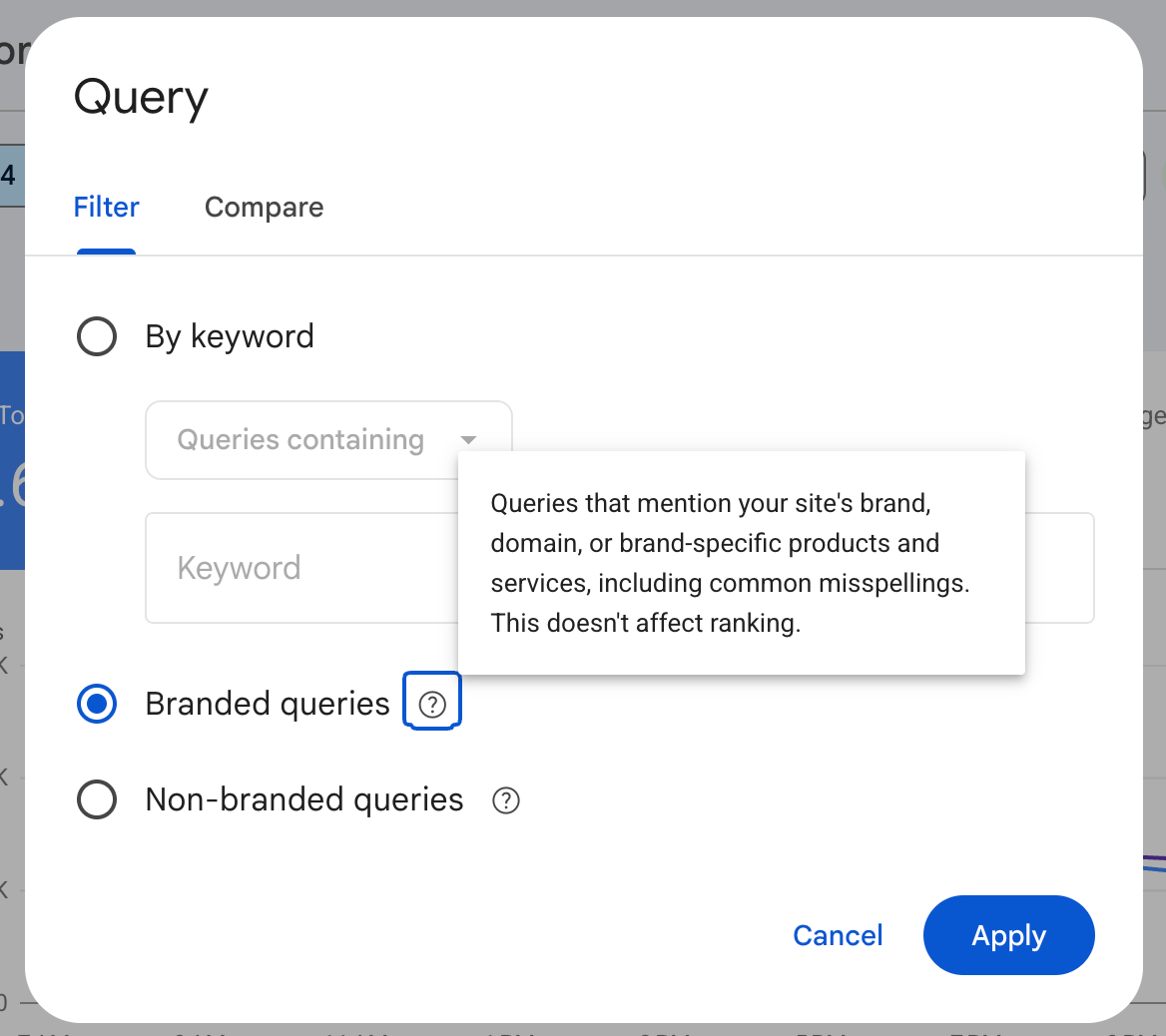
How to measure it: Use Google Search Console’s built-in “Branded queries” and “Non-branded queries” filters. (The query classification is AI-powered and can make mistakes.) Export this filter to review the queries readers use to find your content, and the pages they engage with.
Click-through rate (CTR)
What it is: The percentage of impressions that resulted in a click.
What it measures: How effective a headline, AI mention/citation or social post is at convincing a reader to click your content. Use segmentation by pages, sections or keyword groups (i.e., keywords for set topics, or branded vs. non-branded queries) to add dimension to your data. Over time, improving CTR shows if your search efforts are working.
Why it matters: Earning a click from Google is increasingly challenging. Zero-click results are growing. SparkToro research found that 68 per cent of Google searches end without a click, thanks to AI Overviews and other features that keep readers in the search ecosystem. Earning the click — and getting qualified users to your site — is more important than ever.
Understanding the recipe that wins the click is essential. News and audience editors should analyze high- and low-CTR stories to uncover the topic areas, headline formats and other on-page elements that lead to the highest number of clicks.
How to measure it: Use Google Search Console to see your average CTR for Search, News and Discover. In the Search performance report, look at CTR for queries or pages that are editorially important; on Discover, review the headlines with the highest CTR. Is there a format or topic that’s consistently highly engaging?

AI visibility and citation metrics
What it is: Visibility in AI features, including mentions, citations and cited pages.
Why it matters: As the web evolves, our measures of success must change too. Even if clicks from AI features are significantly lower than traditional results, it’s important to understand where you show up. If your publication isn’t part of the conversation in these environments, you’re missing out on potential audience.
(Caveat: AI visibility can be a challenge to track because attribution limits. Take it with a grain of salt.)
How to measure it: Google Search Console currently provides impression data for AI Overviews (but no clicks). Other tools such as Semrush’s AI Visibility Toolkit, Trisolute News Dashboard and more offer also offer brand AI visibility scores.
The metrics that matter less
Keyword rankings
What it is: A publication’s organic ranking positions in search for specific keywords.
What it measures: Performance on search and how well you rank for keywords. Keyword ranking tells you where your search traffic is coming from and where Google recognizes you have authority.
GSC and other SEO tools provide the average position for a keyword in SERPs.
Why it matters less: Even ranking in “Position 1” often means appearing below sponsored results, an AI Overview and various other SERP features. Ranking, even in the first position, doesn’t guarantee a reader will click a result like it once did; the answer may simply be summarized by an AIO.
GSC reports an average position, but with increasing personalization in search results (notably Preferred Sources), the SERP layout someone sees in New York may vary greatly from London, and the position metric lacks nuance.
What to do instead: Consider multiple metrics and shift your focus. Instead of average ranking, look at total clicks, conversions, CTR and engaged time as a result of ranking for a set of keywords. Ask yourself, what’s the business and editorial impact of this ranking?
Raw page view numbers
What it is: The total number of times a page is viewed in a browser.
What it measures: Volume without value. Total page views to a story in isolation is not meaningful. Hundreds of thousands of page views look great, but if none of those readers subscribe, register or read more than a single story, it’s sugar rush clicks.
(Important caveat: Ad revenue on from high-volume traffic is necessary for some publications; for these sites, pair volume metrics with engagement data. Consider qualified reach: what is the share of page views among returning or frequent website visitors?)
Why it matters less: As Google’s ecosystem changes and the opportunity to generate massive traffic on low-lift content vanishes, this metric should not be counted on.
What to do instead: Shift to engagement and loyalty metrics. Instead of just page view numbers, consider KPIs that reflect direct relationship building: pages per visit, engaged time, conversions, homepage visits, etc. Combined metrics like recency, frequency and volume (RFV), which reflect the depth of the relationship between you and your readers, are more valuable.
THE 201
How to make metrics matter more
A single metric shows where you are right now. Layer on additional dimensions like segmentation or performance over time to get more valuable insight.
Segmentation: How the metric performs against a segment of your data. If measuring conversions from search, what topic or section sees the highest return?
Performance: If the metric is rising, falling or staying the same over time. Month-over-month and year-over-year are fairly standard periods to measure.
Together, this can show how and where your efforts are paying off — and where you need to adjust.
For example: Falling organic traffic following website development changes indicates your tactics are not working and should be reconsidered. A growing number of page views from branded search demonstrates increasing reader familiarity and loyalty.
No single metric is enough to measure success.
A mix of metrics is always going to tell a clearer, more holistic story. Start with clearly defined business and editorial goals: metrics should clearly align with your north star.
The bottom line: It’s not 2023 anymore. Understanding if your search strategy is on the right track requires more nuanced metrics. Consider AI visibility, branded traffic and loyalty metrics as central KPIs, while downgrading the importance of topline figures like page views.
#SPONSORED - The Classifieds

Get your company in front of more than 14,000 writers, editors and digital marketers working in news and publishing. Sponsor the WTF is SEO? newsletter!
RECOMMENDED READING
Google news and updates
🤖 Barry Schwartz: Google employees explain what robots.txt supports.
🤖 Roger Montti: Google’s Sundar Pichai discusses a future where an agentic layer connects Search and AI experiences.
🤖 Barry Schwartz: Google Search ranking is very volatile over the weekend.
Even more recommended reading
🔬 Yulia Deda: AI Overviews appear on 82.5% of brand searches.
🖊 Brodie Clark: AI Overviews spotted summarizing content in citations.
🔗 Cyrus Shepard: How to create links Google can’t ignore.
What did you think of this week’s newsletter?
(Click to leave feedback.)
Catch up: Last week’s newsletter


Have something you’d like us to discuss? Send us a note on LinkedIn (Jessie or Shelby) or email us (WTF is SEO? Newsletter).
Written by Jessie Willms and Shelby Blackley