


Hello, and welcome back. Shelby here, back from a wonderful weekend spent frolicking around Toronto’s west end. Ramen was eaten, cute trinket shops were explored and breweries were visited (and then Legend of Zelda was played). Cap it off with a sunny stroll in Mount Pleasant cemetery, and I’m a walking advertisement for Toronto tourism!
This week: What is commodity content? Leading into our webinar this week with Louisa Frahm, we discuss the differences between commodity and non-commodity content, why publishers should avoid commodity content whenever possible and how it fits into the AI Search era.
📅 Mark your calendars: We’ve partnered up with Trisolute News Dashboard and special guest Louisa Frahm to bring you a workshop on how publishers should approach non-commodity content in the AI era. Ask a question.

Let’s get it.
THE 101
What is commodity content?
“Commodity” refers to content that is generic, basic and based on publicly available or widely known information. It usually lacks depth, first-hand experience, proprietary data or a unique perspective.
Put simply: if an article could be published anywhere without losing meaning, it is commodity content.
The notion of “commodity content” arose when Google’s public Search liaison Danny Sullivan spoke at a Search Central event in Toronto in April 2026. He outlined the differences between commodity and non-commodity content, and how the same topic could be approached differently (see image below).
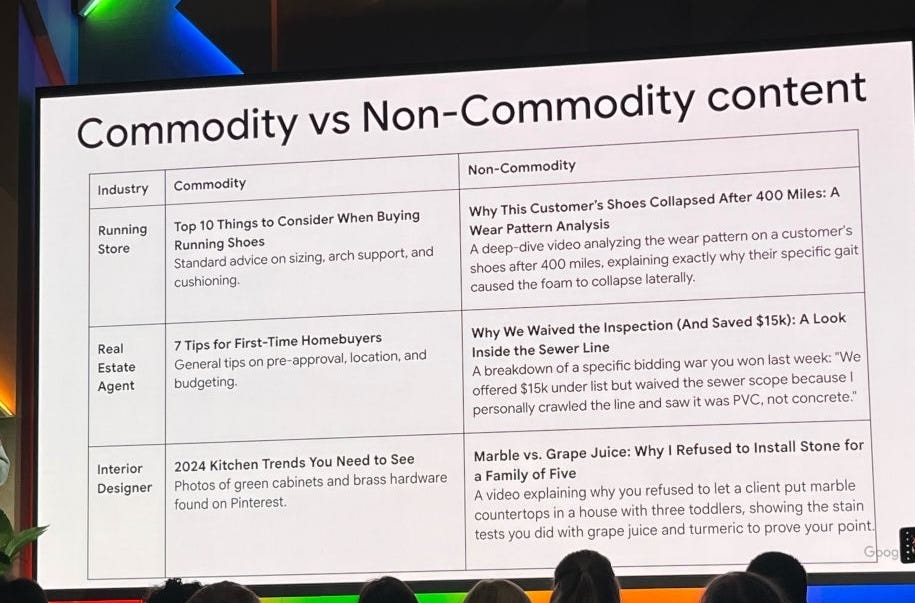
Commodity content is often known as a type of SEO content as it is designed with the main intention of ranking on search engine results pages. It is also easy to produce en masse to rank for a lot of keywords. However, as search behaviour changes — and AI fundamentally disrupts how people are provided information — commodity content should be avoided.
Examples include:
Generic advice listicles, like “10 ways to manage your time”;
Basic question-to-answer articles providing shallow information, like “what time is the Super Bowl?”;
Surface-level product roundups that are compiled solely from Amazon reviews without first-person testing;
Aggregating top-performing competitor articles with SEO-first tactics (specified word counts, headings, etc.).
AI-generated content is often considered commodity content, especially if it doesn’t include any original information.
Google’s AI optimization documentation recommends creating non-commodity content that is helpful, reliable and people-first.
Google directly advises publishers to avoid commodity content that “adds little unique insight for readers.” Google’s guidance mirrors where news SEO is already going: away from generic journalism and toward unique, helpful coverage.
Why was commodity content once beneficial for publishers?
Commodity content was once beneficial because it was cheap to produce at scale with a good return on investment (in large part thanks to programmatic ads).
Google’s ranking systems once rewarded sites targeting top-of-the-funnel, informational keywords with basic SEO best practices: a catchy headline, matching search intent, semantic structure and surface-level information. It was cheap and easy to produce a number of articles on keywords that could branch out (best runners, best runners for children, best runners for marathons, etc.) with an immediate ROI.
Publishers could fairly accurately predict advertising dollars from the impressions on an article. Since these queries had such high search volume, it was an easy formula for monetization through programmatic ads.
When it worked, commodity content did not need depth, original reporting or subject-matter experts (which are all expensive).
It worked — until it didn’t.
Why is it no longer effective (or not as effective)?
Content discovery methods have fundamentally changed. As a result, commodity content is no longer as effective.
Rich Snippets in Google Search were really the first feature to directly impact click-through rate. It answered a question on the SERP, eliminating the need to go to an article. Then, with the launch of AI Overviews, as well as the growing popularity of AI answer bots, basic information is now synthesized everywhere.
Advanced Web Ranking found that AI Overviews appeared on over 80 per cent of U.S. searches tracked. That minimizes the need for people to click through on a basic article even further, driving the value of commodity content down to almost zero.
Therefore, search volume is also no longer anywhere near reflective of traffic potential. Less than one-third of searches still see a click for an article, but the information must be more robust.
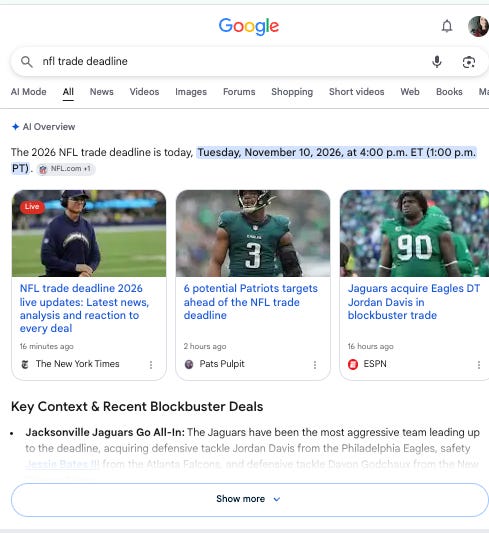
For example, during the 2026 NFL trade deadline, basic information like key dates were summarized right in the SERPs for readers. During a major trade frenzy, AI Overviews summarized top-level information about the moves made by the respective teams. Even though the query “nfl trade deadline” had over 500,000 searches in the United States, there certainly weren’t that many clicks to articles.
Louisa Frahm, SEO and AI consultant, explained that AI is really good at synthesizing basic commodity questions (“is magnesium good for sleep” or “why does my cat purr”).
Instead, publishers can make themselves distinct with original stats or proprietary research. To stay competitive and drive traffic from search, outlets should ask: “If AI could generate the same article without us, what additional value are we bringing to the table?”
The journalism produced needs to be about depth when thinking about visibility in an AI world.
🔗 Read more: Commodity content vs. non-commodity content: Why AI Search is killing generic SEO
Why should publishers avoid the commodity content trap?
Publishers should avoid the commodity content trap for a number of reasons. Firstly, keyword-chasing articles no longer build sustainable traffic or revenue.
Secondly, producing commodity content to scale can hurt your authority and visibility on Search as a whole. Google routinely attempts to remove unoriginal, low-quality sites during core updates (like the current November 2026 update) and has released several spam updates in 2026.
Even when scaled content is successful for a short while, as Glenn Gab warns, “it works until it doesn’t.” Manual actions or site-wide penalties are detrimental.
Writing about any topic just for search traffic does not work anymore, and is a poor approach. Publishers see better returns when focusing on an entity SEO strategy: sites must focus on the topics that the publication is an expert in and can provide insight, not just ranking for anything.
Commodity content is a distraction from a publisher’s long-term success. It diverts budget and resources from projects actually worthwhile. Non-commodity content (which we’ll go into more in a later issue and during this week’s call) is where your investments should go: first-hand accounts with proprietary data, investigative reporting, original interviews and deep analysis.
Non-commodity content cannot be scaled, and that is precisely the point: unique, value-driven journalism is a publisher’s only durable defence in the age of AI.
The bottom line: Commodity content is thin, surface-level information that is easily replicable, and is not recommended for publishers to scale. Consider what makes you different from the competition to stand out in the AI Search era.
#SPONSORED - The Classifieds

Get your company in front of more than 14,000 writers, editors and digital marketers working in news and publishing. Sponsor the WTF is SEO? newsletter!
THE JOBS LIST
Audience or SEO jobs in journalism. Want to include a position for promotion? Email us.
The BBC is hiring a Managing Editor, Audience Development in the U.S. (New York or Washington, hybrid).
The New York Times is hiring a News Assistant Intern (Paris, France).
The New York Times is hiring a Senior Staff Editor for Off-Platform Graphics (New York, hybrid).
The Daily Mail US is hiring a Social Media Editor (New York, N.Y.).
RECOMMENDED READING
Google news and updates
🤖 Google Search: Updates on the November 2026 core update.
🤖 Barry Schwartz: Google November 2026 core update is officially rolling out.
🤖 Google: Introducing Gemini 4 Hydrogen for agentic workflows.
🤖 Google: Search gets a major upgrade with Gemini 4 Hydrogen.
🤖 Barry Schwartz: Gemini 4 Hydrogen is a massive upgrade for Google Search.
Even more recommended reading
📈 Press Gazette: Most popular websites for news in the world: Monthly top 50 listing.
💰 Barry Schwartz: Yahoo Scout to pay publishers through the ILC for using content in AI answers.
🔗 Harry Clarkson-Bennett: “A reader meets you many times before they choose you.”
🚀 Barry Schwartz: Yahoo Search launches Pivot Search, Yahoo Scout app & more.
🖼️ Barry Schwartz: Google AI Overviews AI-generated images are coming back.
🐛 Barry Schwartz: Google Search Console generative AI performance report experienced a data bug.
📉 Rand Fishkin: New research finds that traffic to the open web has fallen 12 per cent in 5 years.
✍️ Chris Green: “F- keywords.” Well, what are you replacing them with?
⚖️ Barry Schwartz: Google loses another round in legal battle against SerpApi over scraping.
💬 Aleyda Solis: A first look at businesses in ChatGPT.
What did you think of this week’s newsletter?
(Click to leave feedback.)
Catch up: Last week’s newsletter


Have something you’d like us to discuss? Send us a note on LinkedIn (Jessie or Shelby) or email us (WTF is SEO? Newsletter).
Written by Jessie Willms and Shelby Blackley