

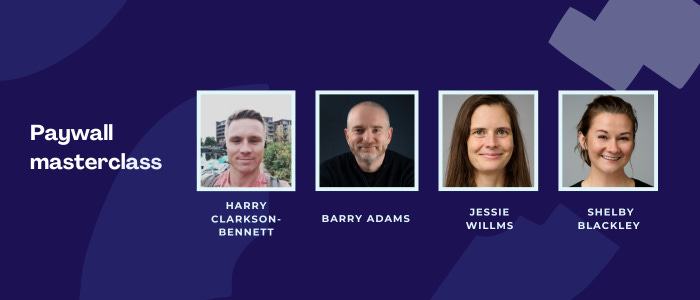
🎉 Launching in early 2026: We’re pleased to present the third workshop in our series of WTF is SEO? masterclass calls! 🎉
Join an all-star news SEO lineup for a masterclass on paywall SEO for publishers. Jessie Willms and Shelby Blackley (WTF is SEO?), Barry Adams (Polemic Digital), and Harry Clarkson-Bennett (Leadership in SEO) will lead attendees through a series of paywall tactics and strategies in this two-hour workshop.
Hello, and welcome back. Jessie and Shelby here, back from a snowy weekend in Toronto. We both went to Canada’s biggest craft fair, the One of a Kind Show (tell us in the comments who is more likely to have blown their budget!). Jessie also went to a gift exchange (and somehow went home with her own gift!) while Shelby had a few wobbly pops at a Christmas drag show before hitting up a karaoke bar. Very similar weekends, clearly.
This week: It’s the end of the year! Can you believe it? We dive into the archive and pull out our favourite newsletters, and the top advice from a looooong year in news SEO.
ALSO! Catch us at ONA26 in Chicago on March 30-April 1! We’ll be doing a session on balancing a full-time job with a side hustle (while having a life), and a few other talks! And we love meeting community members!
Let’s get it.
THE BEST OF 2025
Technical SEO
Must-know technical SEO topics include: Crawling, indexing and ranking (how Google works); ranking factors (signals used to rank content); algorithm updates (Google’s attempt to improve results); website structure; internal linking (how pages are connected); backlinks (authority signal from external sites); core web vitals (metrics of site experience); structured data (explicit clues for Google about a webpage); duplicate (multiple) and thin (not enough substance) content.

Ask the SEO Experts: Handling algorithm updates
Lily Ray, Michael King and Ryan Sammy unpacked how the March 2025 Google core algorithm update affected publishers. They also offered advice about changes on search. Their tips? Shift from chasing traffic to focusing on deeper content value, brand building and bottom-of-the-funnel engagement. For overall algorithm strategies, don’t do “anything too risky,” says Lily. More often than not, you won’t get dinged if you stay the course.

What is GEO?
Generative Engine Optimization: One of (many) acronyms about optimizing content for generative AI engines and visibility in chatbots. There’s a lot of overlap between “GEO” — something the industry still isn’t quite sold is a discipline — and SEO. The best practices remain the same: produce quality content in your niche, have a technically sound site and increase brand awareness.

The five headline fields
There are five headline fields that Google recognizes and publishers can optimize for (if their CMS allows). They are: the on-page visible headline <h1>; the <title> tag; the structured data headline; the open graph title; and the homepage/internal link headline. Not every site can optimize for all five, but each field helps reach different audiences or platforms. If you can, do so to increase reach and performance.

Three AI tools
There are a ton of AI and AI-powered tools on the market. What matters is the tool that works for you. News SEOs can leverage ChatGPT for data wrangling and competitive analysis, or use AI-powered features in Semrush or Ahrefs to enhance content optimization, keyword research and other tedious tasks. Human intervention is always needed with any AI.

Content SEO
Must-know content SEO topics include: E.E.A.T (a framework for evaluating content quality); topic authority (subject matter expertise; keyword research (the information people are looking for); search intent (the why behind a query); and on-page SEO (the on-page elements like headlines, subheadings, metadata, URLs, images and internal links).

Query fan-out
Query fan-out is the process that powers Google’s AI Mode. It explodes a user’s single prompt into many related subqueries, pulling passage-level snippets from numerous sources — and mediums, including text, video and maps — into responses. It’s a major shift in how Google works as it collapses the traditional search journey into a single path and reduces reliance on multiple sources — and publishers.

Zero-click search (what is and what to do)
Zero-click search occurs when a user types something into Google and the answer is directly on the results page, eliminating the need to click. Accelerated by AI Overviews and AI Mode, it’s a threat to publisher traffic.

How experts advise publishers respond:
Louisa Frahm, SEO director at ESPN: “Emphasize brand visibility and direct relationships with readers.”
Alexia LaFata, senior manager for SEO at Vox Media: “Build a brand so strong and authoritative that a reader will want to check out your content no matter where [you appear].”
Clara Soteras, SEO consultant for news publishers: “Strengthen both the brand and the product itself, building something genuinely unique that fosters audience loyalty.”

Two highlights from NESS: Discover and paywall strategies
Stand-out NESS sessions included Lily Ray’s presentation on Google Discover and Harry Clarkson-Bennett’s talk on publisher revenue.
Lily reiterated that the best headlines feature authority figures, concrete numbers, strong emotion or controversy. Optimal length: 90–105 characters (and not more than 130 characters).
Harry explained that paywalls work best when content is unique and high-value. To succeed, SEOs should maximize traffic value, advocate for paid search and build AI-resilient assets.


The bottom line: 2025 was a year full of changes in news SEO. Publishers faced volatility on the SERPs and declining traffic. The response to these threats is a strong focus on high-quality and unique content, building distinct brands and direct relationships with readers.
#SPONSORED - The Classifieds

Get your company in front of more than 13,500 writers, editors and digital marketers working in news and publishing. Sponsor the WTF is SEO? newsletter!
THE JOBS LIST
Audience or SEO jobs in journalism. Want to include a position for promotion? Email us.
The Times and Sunday Times are hiring an SEO editor (London, UK).
RECOMMENDED READING
Google news and updates
🤖 Google (breaking!): Introducing social channels directly in Search Console.
🤖 Google: AI-powered configuration for analysis is coming to Search Console.
🤖 Barry Schwartz: Google home page search bar upload feature goes directly to AI Mode results.
Even more recommended reading
🚨 Robert Hart: OpenAI declares ‘code red’ as Google catches up in AI race.
✏️ Marie Gilot: My Nieman Lab 2026 news prediction: The explainer is dead.
🤔 Sam Kriss: Why does AI write like … that?
🗑️ Kat Tenbarge: AI slop is ruining Reddit for everyone.
🔍 Nick LeRoy: Niche down: Your guide to specializing in SEO.
📈 Gianluca Fiorelli and Cyrus Shepard: Decoding Google’s updates: What truly drives visibility today.
🤑 Aleyda Solis: Top Black Friday organic search traffic winners and trends in 2025.
What did you think of this week’s newsletter?
(Click to leave feedback.)
Catch up: Last week’s newsletter


Have something you’d like us to discuss? Send us a note on Twitter (Jessie or Shelby) or to our email: seoforjournalism@gmail.com.
Written by Jessie Willms and Shelby Blackley
Great insights here! Consistent efforts like these are what strong Toronto SEO Services deliver. https://growbusiness.ca/toronto/
Helpful and to the point. Anyone serious about rankings should look into Toronto SEO Services. https://growbusiness.ca/toronto/