

Hello, and welcome back. Jessie here, back from the first weekend of the men’s World Cup touching down in Toronto! The streets (if not the stadium) are full of boisterous energy. And while I’ll leave most of the soccer-watching to folks who know a “yellow card” not just as a one-hit wonder, for me, it was a weekend full of fitness: tennis, a Hyrox class, softball and — in a truly shocking turn of events — I even went for a run.
This week: Expert tips ahead of the summer Prime Day event. Last week, we recapped eight tips for affiliate-focused SEO work. This week, we’ve got last-minute expert tips from a handful of search pros.
🚨 Happening soon: We’re partnering with Marfeel to bring you an interactive discussion about AI in Search — and what to do about it — on June 22, 2026 at 11 a.m. ET./3 p.m. GMT. Have a question or want a calendar reminder? Use this form!
Let’s get it.
THE 101
Affiliate SEO: Quick hits and highlights
Affiliate SEO is the process of optimizing stories that use referrals to sell products or services, where the publisher makes a commission off the purchase. The goal is for users to click an affiliate link and buy a product.
Tentpole events — regularly occurring moments like Prime Day, Black Friday or even Father’s Day — offer sites an opportunity to capitalize on a surge of high-intent search interest, and drive stronger-than-average revenue.
Tentpole coverage includes roundups of the best overall sales on a product, deal alerts, as well as product- or retailer specific guides.
As always, the fundamentals of a solid search strategy for affiliate marketing consists of the same pillars as effective news SEO.
That means a technically-sound website, strong E.E.A.T signals and topic authority, keyword research to inform content production, as well as individual pages and articles that are well-optimized (with specific attention paid to headlines, subheadings and internal links) for readers and Google.
THE HOW TO
What are news SEOs saying about Prime Day?
If affiliate SEO (and all SEO, really) is a marathon — Prime Day is a sprint.
Like a marathon, you need proper training long before the starting line of an event. This is done by building solid E.E.A.T. and topic authority. But, Prime Day is a sprint; it’s only a four-day event, this year landing between June 23-26, and requires all-out effort.
With that in mind, we asked top news SEOs for their advice on winning the race — and executing a successful Prime Day strategy.
Their advice reflects a few core strategies: stay flexible, monitor Google results changes and make use of real-time trends — but don’t pack up too early. Here’s what to know.
Monitor Google results page changes
Google is volatile — and SERPs during a live news event like Prime Day are no exception.
“Prime Day offers no guarantees except surprises,” says SEO consultant Isaac Brown. That means publishers need to be nimble and build flexibility into their editorial pipelines. Keep a reporter free for breakouts, or one-off pieces.
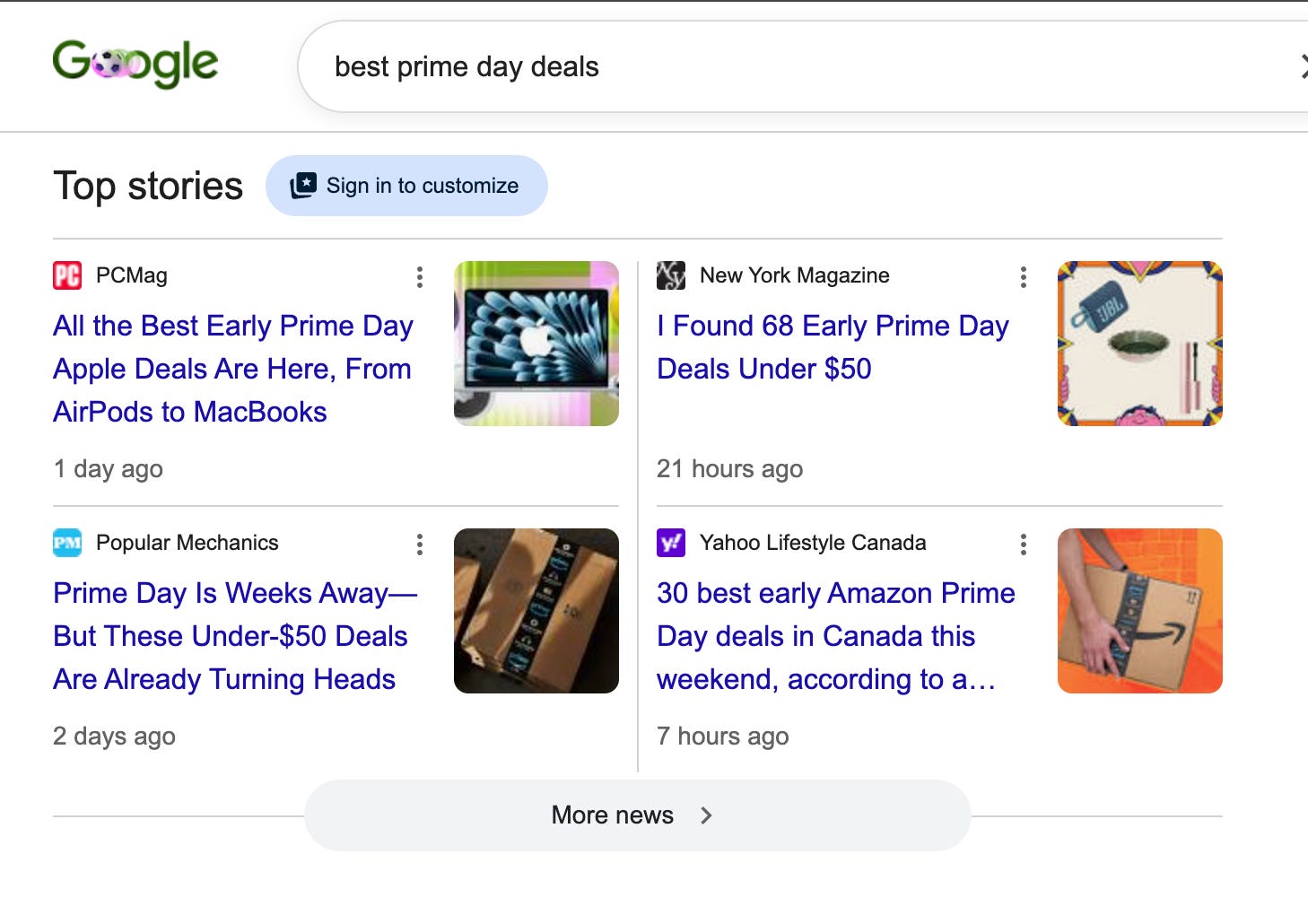
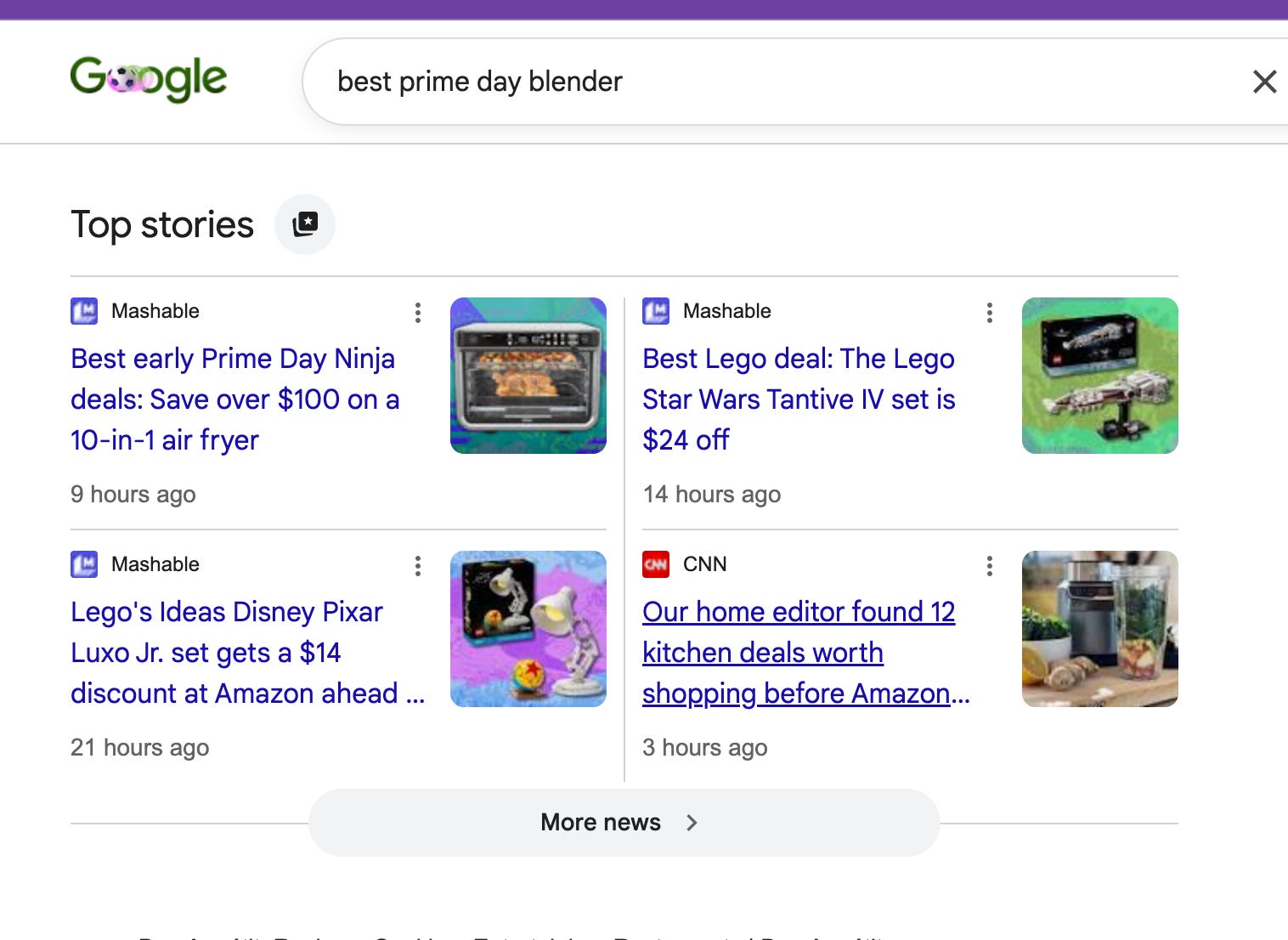
Expect Google to throw some curveballs. With less than two weeks until Prime Day, Google is showing an AIO for “best prime day deals,” followed by a Top Stories news box. That could change — even during Prime Day.
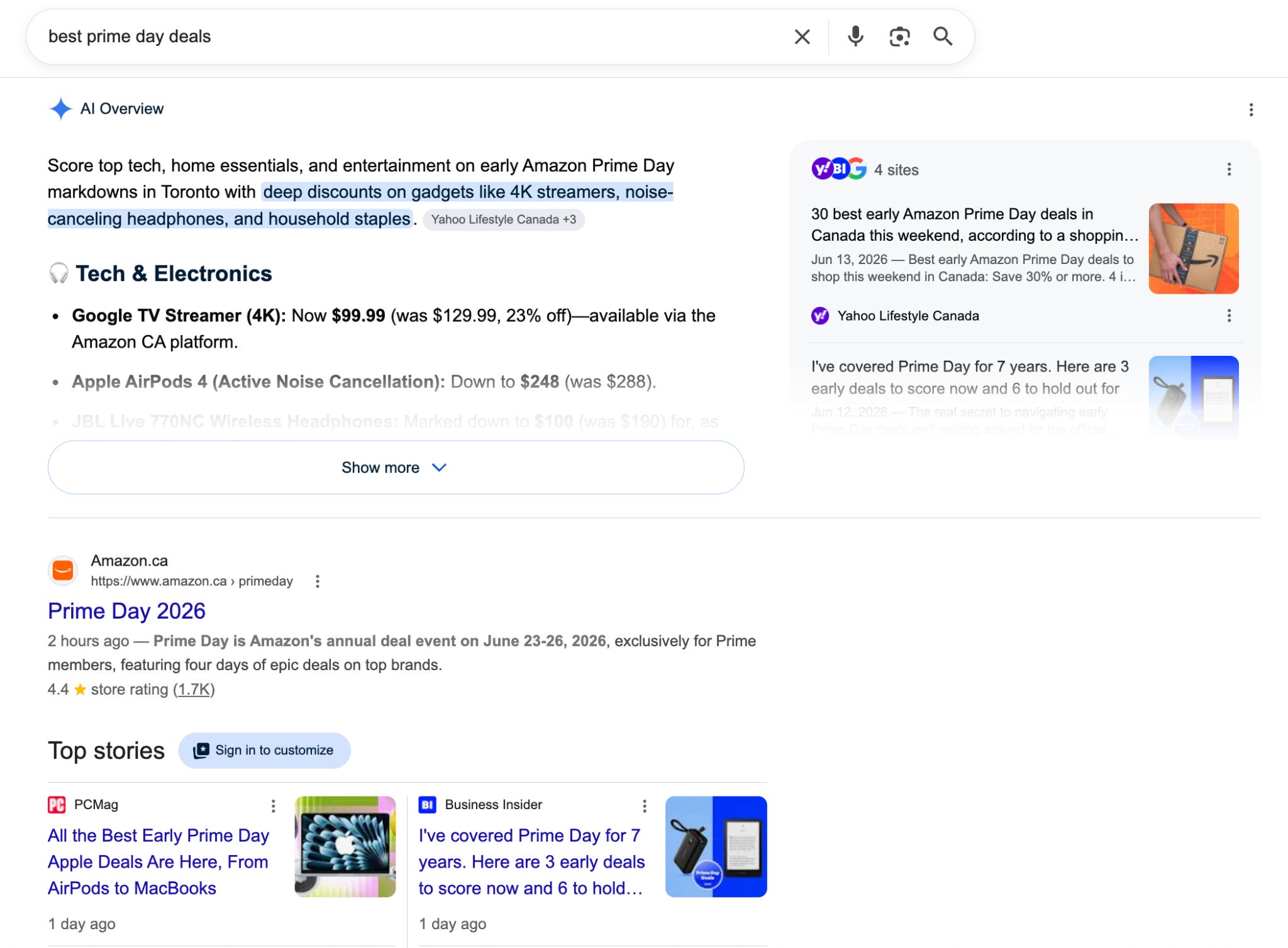
“We’ve seen Top Stories carousels appearing inside AIOs for some queries recently,” Isaac says. “That is highly concerning because we can guess what that will do to the click-through rate.”
Craig Casazza, Senior Product Director for Dow Jones and the Wall Street Journal, agrees. “It’s a safe assumption that your visibility will be less than it was a year ago, and even less than the year before that,” he says. “This may be the first big sales event where AIO is a major factor.”
And it’s not just AI Overviews taking up real estate. Sites like Reddit, X and YouTube are in the mix, too, with more visibility than ever. It’s likely to continue.
“In the past, Google has experimented with showing What People Are Saying carousels more during deals events and shifting us into those instead of Top Stories,” he says. “We have to be ready for anything.”
Plan for the unexpected. Google’s current landscape leaves fewer opportunities for click, but search results still offer other entry points. If Instagram or Reddit is everywhere on Google for those key terms, are your best stories on those platforms?
Consider a multimodal approach to your coverage. Aim to find readers where they’re spending their time.
Use Google Trends to inform you real-time coverage
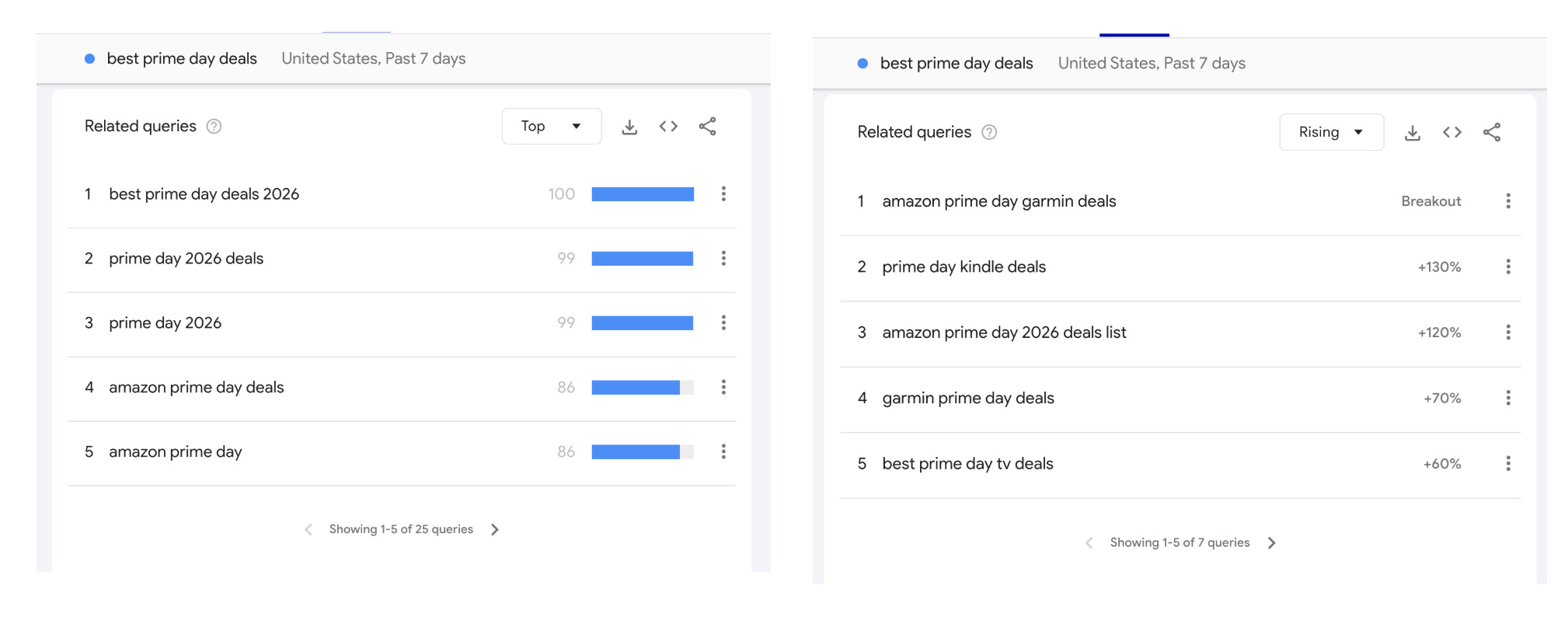
Instead of competing solely for the highest volume (and, most likely, highest competition) terms like “best prime day deals,” use Google Trends to uncover opportunities where the competition might be thinner. Don’t just look at the “Top” queries; monitor “Rising” terms, too.
Google Trends defines a “Rising” query as those with “the biggest increase in the specified location and time period compared to the previous time period.”
SEO strategist Melissa D. Cooper recommends looking at the “Rising” terms to see “what deal topics are growing in interest.”
For example, using the term “best prime day deals,” Google Trends shows that the Top queries are focused on broad event queries. Rising reflects more specific terms, like “prime day kindle deals” or “garmin prime day sales.” If your site covers tech or running gear, these could be opportunities.
If a product or niche topic that’s core to your coverage spikes in interest, write a quick post. If the piece gets good traction (in revenue or traffic), keep updating and adding to the piece
“Publishers need to constantly align their titles, headers, and subsections with the exact search intent of the moment, rather than relying on generic best deals formatting,” says Craig.
Plan, but stay nimble
Winning Prime Day — or any tentpole event — often comes down to smart resource allocation and being flexible with your editorial plans.
Ahead of Prime Day, establish your ideal refresh cadence for key pages (like an overall deals roundup or product-specific trackers) during the event.
“Establish ahead of time how often you think pages will need to be updated,” says Craig. “Budget that in when determining resourcing for the event.”
Communicate this clearly to writers and editors so you have fresh coverage (and timestamps) day-of; this also means your content will be the most useful to readers. (Clicking through to an expired discount code or just-ended sales is a bad user experience!)
However, have the flexibility to pivot — and the willingness to abandon underperforming pages.
“Closely monitor which types of roundups are resonating with searchers or gaining search ground throughout the day,” says Isaac.
It’s possible the content you thought was going to be a hit won’t resonate with readers or land on Google Search or Discover.
Tracking and understanding what content — i.e., which formats or topics — Google is rewarding is essential.
“It used to be that deal roundups drove the most traffic and revenue,” Craig says. “We saw starting with Prime Day in 2024, however, that individual deal posts were starting to outperform due to reach on Google Discover.”
If a specific product post isn’t driving traffic, don’t waste resources updating it. Put that energy behind what the data — internal revenue and traffic metrics, alongside SERPs intel — suggests is working.
Don’t call it quits too early
Joy Johnston, News SEO Strategist for Trisolute News Dashboard, suggests publishers should consider keeping their coverage going after June 26 — specifically with live blogs or for still-active deals.
“Multiple publishers continued to gain good mobile news box visibility in the 2-3 day window after Prime Day 2025 officially ended,” she says. The official end of the event isn’t necessarily the end of consumer interest.
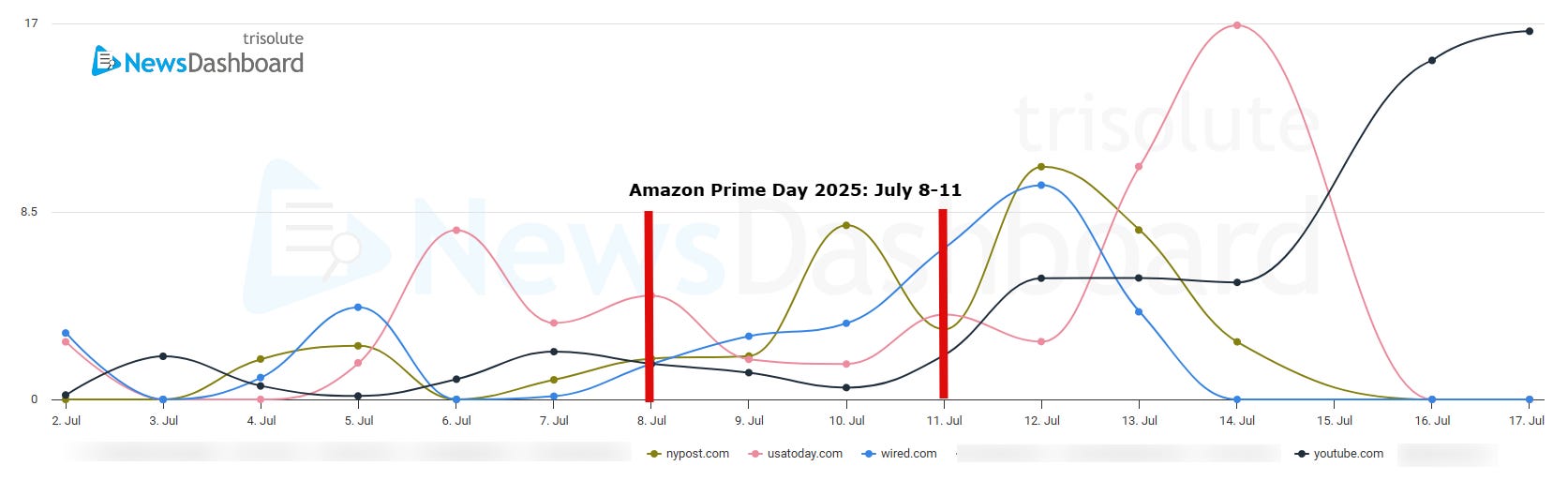
Notable publishers like Wired, the New York Post and USA Today had their strongest ranking in the news box after the event formally wrapped.
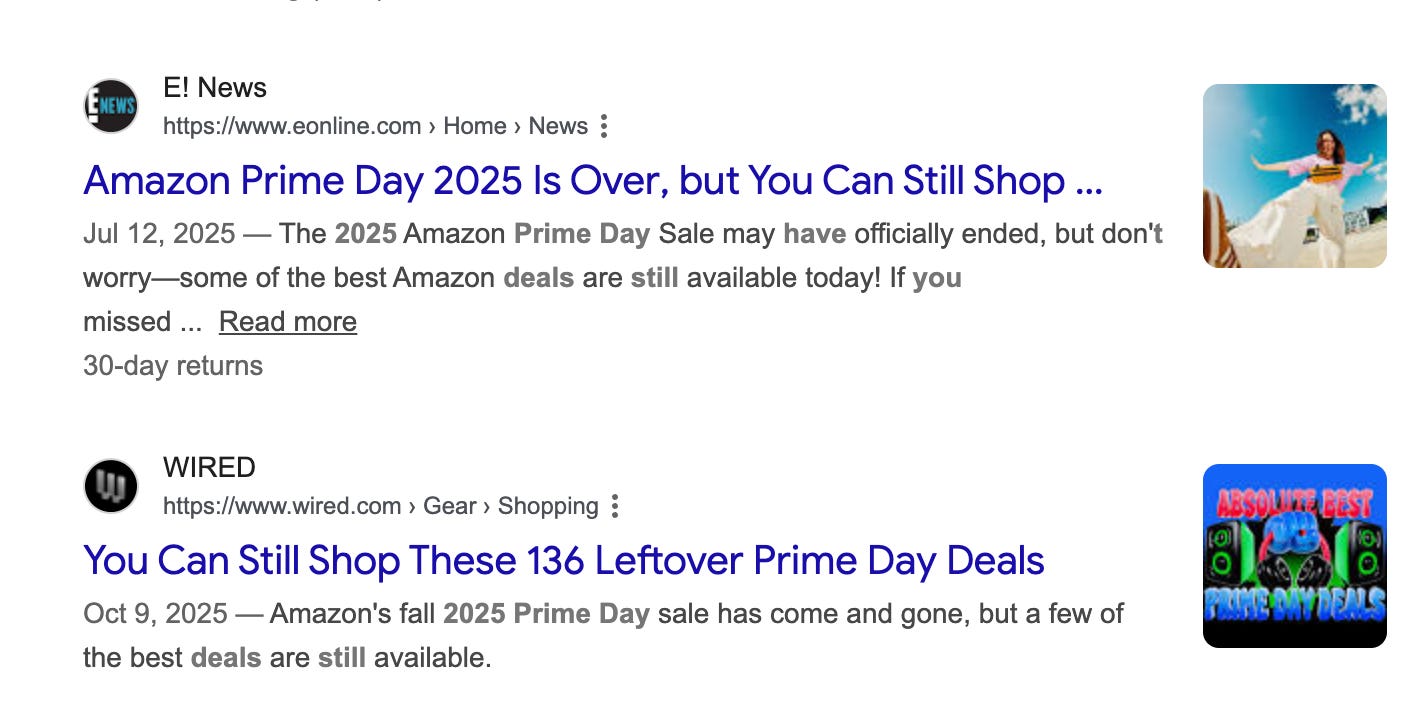
Joy also suggests to keep your coverage relevant post-event, consider publishing new angles. For the aforementioned publishers, several post-event angles that focused on still-active sales help drive extended visibility on search.
Joy also found that focusing on a specific product category (like laptops or TVs) or a specific brand with notable search interest (like Apple News) worked well in 2025. Effective headlines create a sense of urgency for users, for example, “you can still shop these deals.”
Encourage loyalty now, to help you in the future
Promoting audience loyalty is essential, Melissa says: “Now is the time to push your audience to add your site as a Preferred Source on Google. Link directly to adding your site as a Preferred Source in your articles, newsletters, and social posts.”
Doing this now could pay dividends in the future, she says.
Come Black Friday in November, as well as the busy holiday season, we don’t know what Google might look like for commercial and transaction queries — but we do know that the added visibility gained by Preferred Sources can be useful for publishers.
The bottom line: Prime Day can be chaotic, but essential for your success as an affiliate publisher. Use Google Trends to uncover coverage opportunities, refer to Google SERPS to see what’s resonating on search, and consider extending your coverage after the official event ends — it could be the secret to driving extra traffic.
Tune into our AI in Search conversation [together with Marfeel]
![Tune into our AI in Search conversation [together with Marfeel]](https://substackcdn.com/image/fetch/$s_!V_kI!,w_280,h_280,c_fill,f_webp,q_auto:good,fl_progressive:steep,g_auto/https%3A%2F%2Fsubstack-post-media.s3.amazonaws.com%2Fpublic%2Fimages%2Feb4f20a3-e220-4291-9bd8-aa6d28016ab7_5472x3648.jpeg)
Are you worried about AI in organic search? What insights are your missing from an SEO tool to better understand your site’s performance?
If you’re in any way thinking about AI and search, this call is for you.
THE JOBS LIST
Audience or SEO jobs in journalism. Want to include a position for promotion? Email us.
The Wall Street Journal is hiring an Audience Strategist, Enterprise & Investigations (New York, New York).
RECOMMENDED READING
Google news and updates
🤖 Danny Goodwin: Google can be directly liable for false AI Overview claims, ruled the Regional Court of Munich.
🤖 Barry Schwartz: Google adds guidance on third-party SEO tools, services, advice and updates hiring an SEO doc.
Even more recommended reading
‼️ Rand Fishkin: In 2026, less than one-third of Google searches still send a click.
⛔ Roger Montti: Anthropic forced to shut down Fable 5 by U.S. government order.
🌍 Barry Adams: Google is building an Audience Loyalty ecosystem.
🧰 Emina Demiri-Watson: Why your product feed is an SEO asset (and who should own it).
✊ Shahzad Abbas: Publishers of the world, unite!
What did you think of this week’s newsletter?
(Click to leave feedback.)
Catch up: Last week’s newsletter


Have something you’d like us to discuss? Send us a note on Twitter (Jessie or Shelby) or to our email: seoforjournalism@gmail.com.
Written by Jessie Willms and Shelby Blackley
Yup
Spot on. You completely nailed the reality of optimizing for Prime Day, especially with the compressed June timeline this year. Getting those last-minute affiliate SEO strategies dialed in is exactly what brands need to actually win the event.
I curate a blog covering these exact search engine optimization and e-commerce growth strategies. I’d love to connect and do a subscription swap so we can help each other grow. Keep the great expert roundups coming!